

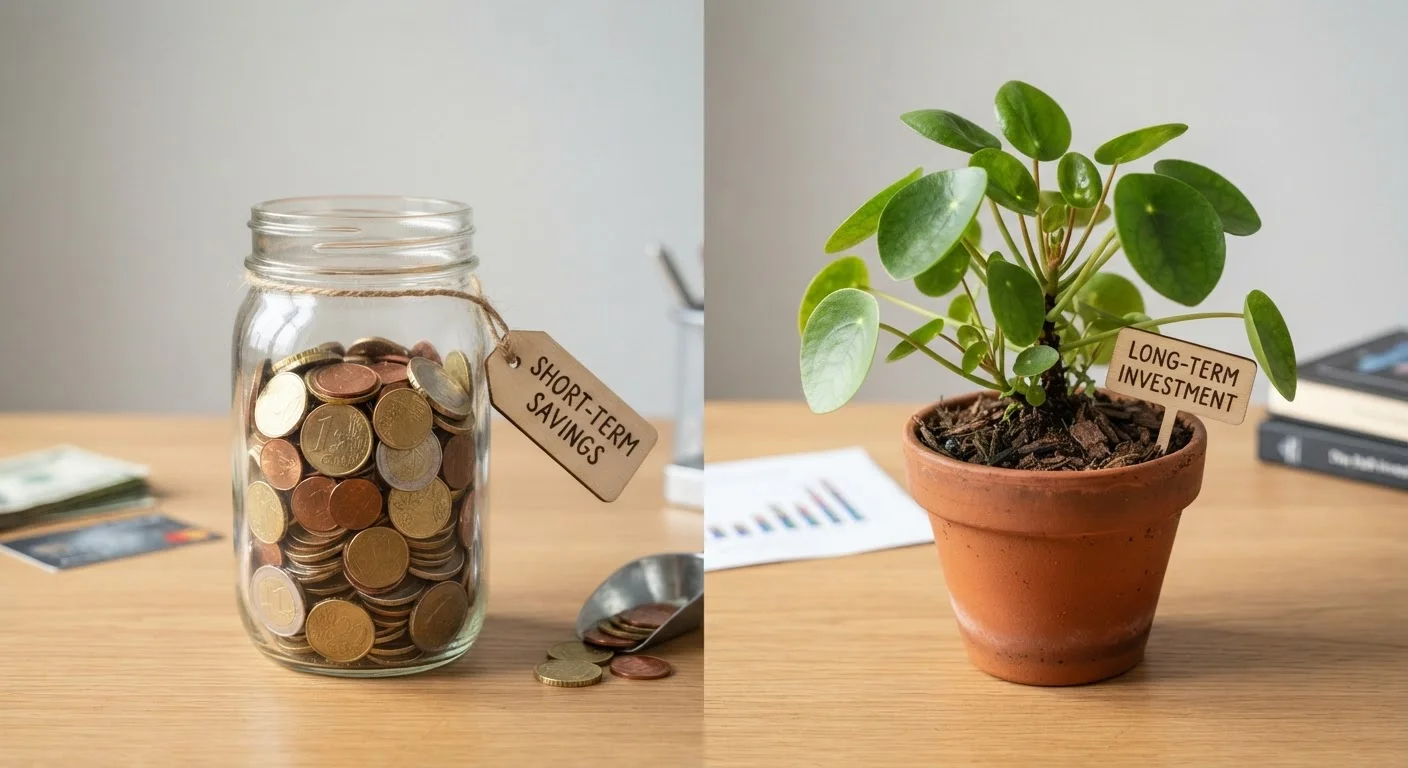
Why the distinction matters
Many people treat all financial goals the same: save more, spend less. That approach misses a meaningful difference in how money should be managed depending on when you need it. A goal you want to reach in 18 months calls for a completely different account type and strategy than one you are working toward over 25 years.
Conflating the two creates real problems. Keeping retirement money in a savings account means missing decades of potential compound growth. Parking a house down payment fund in volatile investments risks a sharp loss right before you need the cash. Understanding which goal is which helps you match each one to the right financial tool.
For a broader look at how these two categories compare across account types and timelines, see the difference between short-term and long-term savings goals.
Short-term savings goals: what they are and how to fund them
A short-term financial goal generally has a target date within one to three years. Common examples include building an emergency fund, saving for a vacation, replacing a vehicle, or covering a planned medical expense. The defining feature is that you will need the money soon, so protecting what you have saved matters more than growing it aggressively.
Appropriate accounts for short-term goals include high-yield savings accounts, money market accounts, and short-duration certificates of deposit (CDs). These options keep your money accessible, insured (up to applicable FDIC limits), and largely shielded from market volatility. The trade-off is modest interest, which is acceptable because capital preservation is the objective.
Automating contributions, even small ones, makes consistent progress more reliable than relying on willpower. For strategies to build that consistency, proven approaches for staying consistent with a savings goal covers research-informed habits that hold up over time.
Label each savings account by goal
Opening separate savings accounts for distinct goals, such as one for an emergency fund and another for a vacation, removes ambiguity about how much progress you have made toward each target. Many online banks allow multiple savings accounts with custom nicknames at no added cost. This separation also reduces the temptation to spend money set aside for one purpose on another.
Long-term investment goals: growth over time
Long-term goals, generally those more than five years away, can tolerate more volatility in exchange for the possibility of higher growth. Retirement is the clearest example, but financial independence, funding a child's college education, or buying a home a decade out also fit this category.
Tax-advantaged accounts such as 401(k)s and IRAs are common vehicles for long-term goals, alongside taxable brokerage accounts for goals that fall outside retirement. Because the time horizon is long, a portfolio can include a higher proportion of equities, which have historically delivered stronger growth than cash-equivalent instruments over multi-decade periods, though past performance does not guarantee future results.
Understanding your risk tolerance is a necessary step before deciding how to allocate a long-term portfolio. The right mix of assets depends on your timeline, your income stability, and how you would realistically respond to a significant temporary decline in account value.
If you have not yet started, a beginner's roadmap to investing for retirement explains the foundational account types and first steps.
How to plan for both at the same time
Running short-term and long-term goals in parallel is entirely workable with the right structure. The core idea is to treat each goal as a separate bucket with its own account, contribution schedule, and target amount. Mixing funds in one account makes it harder to track progress and easier to raid savings earmarked for one purpose to cover another.
| Short-term savings | Long-term investment | |
|---|---|---|
| Typical time horizon | Under 3 years | 5 or more years |
| Primary objective | Capital preservation | Growth over time |
| Common account types | High-yield savings, CDs | 401(k), IRA, brokerage |
| Risk tolerance needed | Low | Moderate to high |
| Liquidity | High | Lower (penalties may apply) |
| Role of market volatility | Avoid exposure | Manageable over long horizon |
Sequencing also matters. Understanding whether to build an emergency fund or invest first lays out the financial logic behind that ordering decision. Generally, a baseline cash reserve comes before discretionary investing, because without it, an unexpected expense forces you to liquidate investments, potentially at a loss.
Once the emergency fund reaches a functional level (commonly three to six months of essential expenses), directing additional dollars toward long-term goals becomes more sustainable. The budgeting basics hub has practical strategies for finding that room in a monthly spending plan.
Reviewing both categories at least once a year keeps the plan relevant. Life circumstances shift: income changes, new goals emerge, and timelines move. An annual financial planning checklist can guide that review efficiently. For those starting from scratch, building your first long-term financial plan provides a structured starting point.
This article is for informational purposes only and does not constitute personalized financial, investment, tax, or legal advice. Consult a qualified financial professional before making decisions specific to your situation.


