

The problem with focusing only on dollars
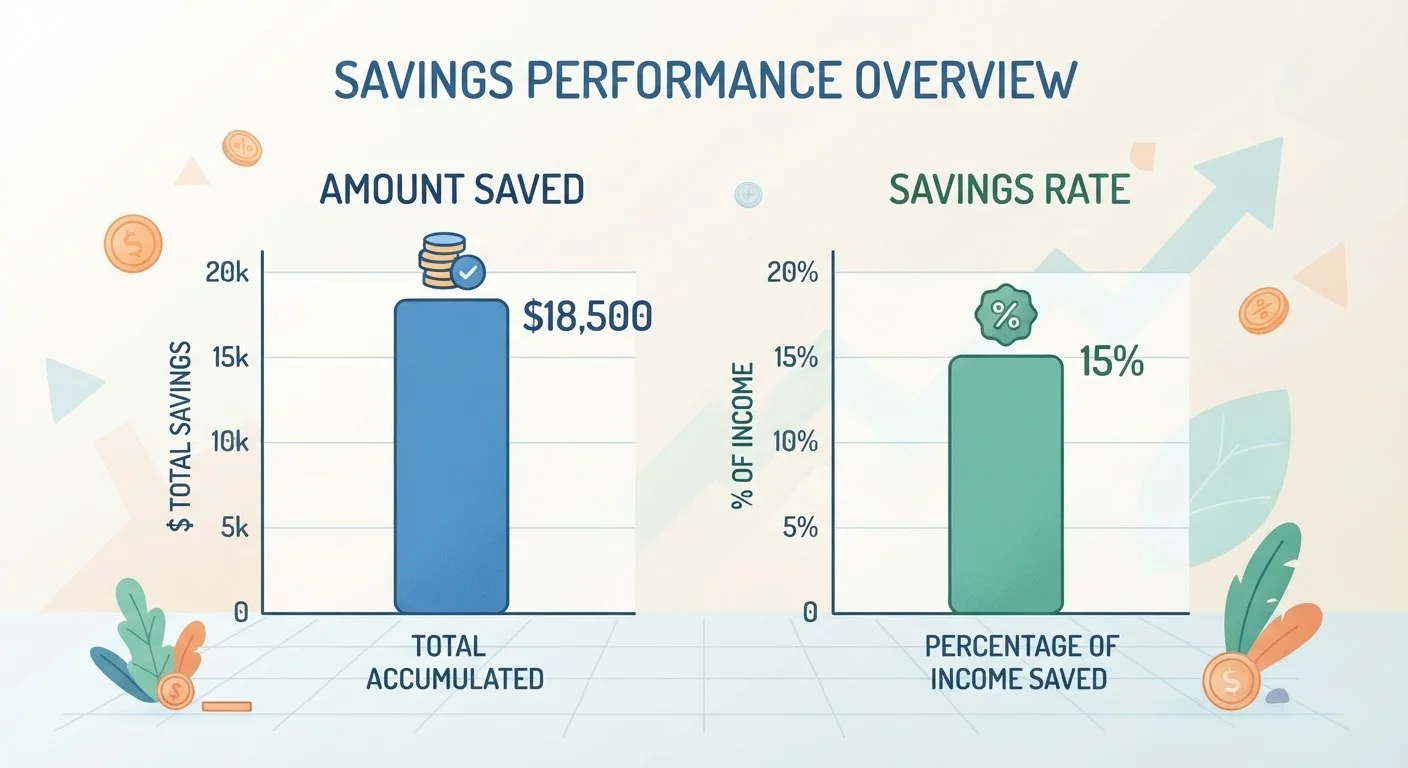
When someone says they save $500 a month, that number sounds meaningful in isolation. For a person earning $25,000 a year, saving $500 monthly represents a 24 percent savings rate. For someone earning $120,000 a year, the same $500 represents about 5 percent. The absolute amount is identical; the financial behavior behind it is completely different.
Focusing on dollar amounts alone can mask whether your savings habit is genuinely strong or just a byproduct of a high income. It also makes it nearly impossible to benchmark your progress against your own earlier behavior or against widely used planning targets.
Savings rate cuts through that noise. It scales with your income, so it remains a valid measure whether you earn $28,000 or $280,000. That consistency is what makes it a more durable indicator of financial behavior than any fixed dollar figure.
~5%
U.S. personal savings rate (recent years)
The U.S. Bureau of Economic Analysis tracks the personal saving rate, which has fluctuated between roughly 3 and 8 percent for most of the past decade outside of pandemic-era anomalies.
15-20%
Commonly cited retirement savings target
Many retirement planning frameworks recommend saving 15 to 20 percent of income (including employer contributions) to maintain living standards in retirement.
25x
Estimated assets needed at retirement
A widely referenced rule of thumb suggests accumulating assets equal to 25 times annual expenses for a sustainable retirement, a figure directly tied to your ongoing spending rate.
How savings rate shapes long-term outcomes
The connection between savings rate and long-term financial health runs through two mechanisms working together. First, a higher savings rate means more money accumulating and compounding in savings or investment accounts. Second, and less obviously, it usually means your lifestyle costs less, so you need fewer total assets to sustain it in the future.
Consider two workers who both retire with $500,000. One saved at a 5 percent rate throughout their career and maintained a high-spending lifestyle; their nest egg may cover only a few years of expenses. The other saved at 20 percent, kept spending modest, and the same $500,000 stretches considerably further. The dollar amount is the same; the outcomes diverge.
For anyone working toward financial independence, retirement, or simply a larger cushion against disruption, savings rate gives a clearer signal of trajectory than watching an account balance grow in absolute terms. See our guide to short-term vs. long-term savings goals for how your rate should inform which type of goal you prioritize.
How to calculate and track your own rate
The calculation is straightforward. Take the total amount you save in a month (including retirement contributions, transfers to savings accounts, and any extra debt repayment you choose to count), divide it by your take-home income for that month, and multiply by 100. If you save $600 out of $3,500 in take-home pay, your rate is roughly 17 percent.
Tracking it over time matters more than any single month's number. A one-month snapshot can be distorted by an unexpected expense or an irregular paycheck. A six- or twelve-month average tells you where you actually stand.
Many people find that simply measuring their rate regularly changes their behavior. When spending decisions are visible as a percentage of income rather than an abstract dollar amount, the trade-offs become clearer. A $200 impulse purchase means less when the account has thousands in it; it is harder to dismiss when you can see it shave a point off your savings rate for the month.
For practical methods to keep the habit going, the strategies for staying consistent with a savings goal article covers approaches that work over the long term.
Raising your rate when income is limited
A common objection to savings rate thinking is that it feels irrelevant when income barely covers necessities. That concern is legitimate. Structural constraints on income are real, and no percentage target changes a housing cost that consumes 50 percent of take-home pay.
Still, savings rate thinking is useful even in tight circumstances because it directs attention toward the right variable: the gap between income and spending. A small rate is not a failure; it is a starting point. Even moving from 1 percent to 3 percent saved each month builds a habit and a buffer.
Expense reduction is typically faster than income growth as a way to raise the rate. Auditing recurring charges, renegotiating bills, or shifting one discretionary category can move the rate without waiting for a raise. The practical strategies for building savings on a tight budget article addresses this directly for people working with narrow margins.
Whether you contribute a lump sum or steady smaller amounts also affects how your rate looks month to month. Comparing lump-sum versus regular contributions can help you decide which approach fits your cash flow pattern.
This article is for general informational purposes only and does not constitute personalized financial advice. Consult a licensed financial professional for guidance specific to your situation.


