How the connection type actually affects sound
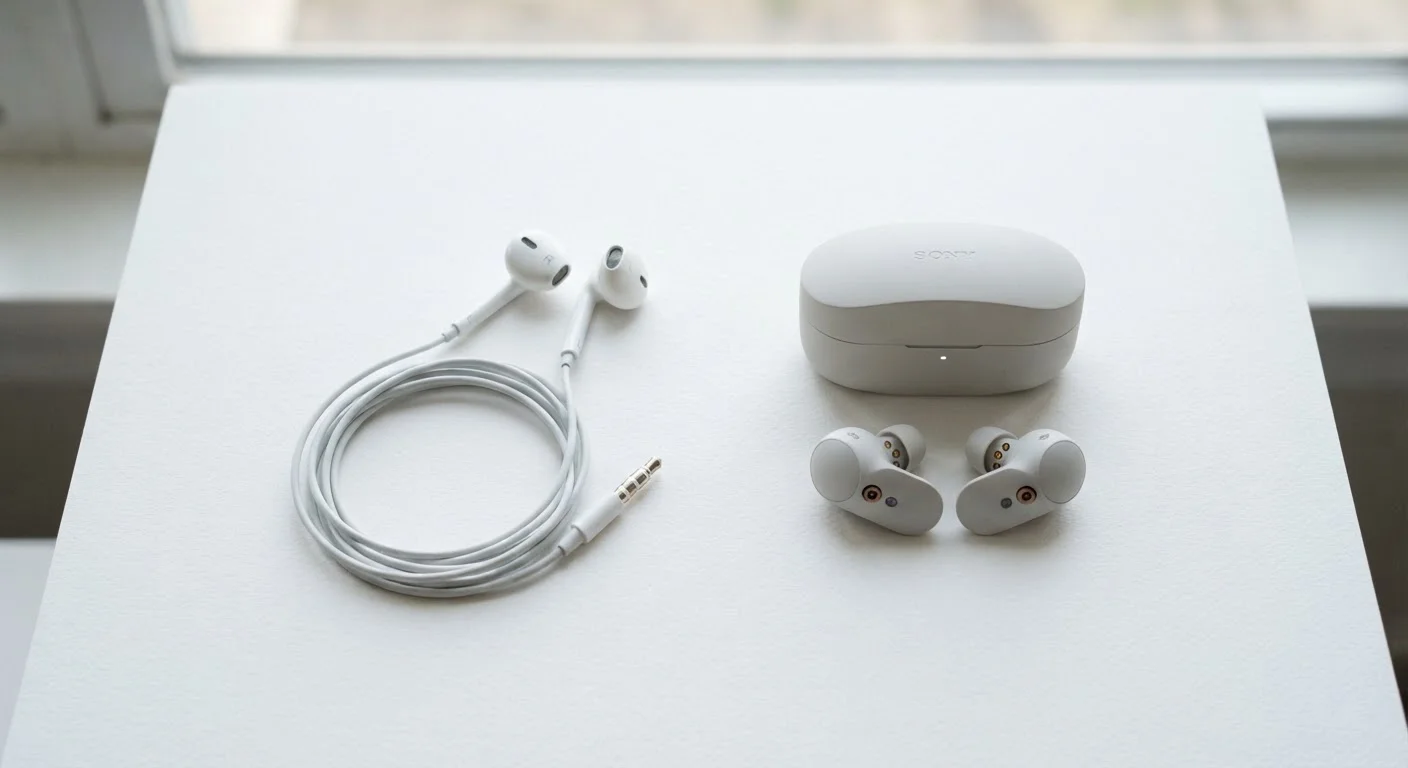
A common belief is that wired earbuds always sound better than wireless ones. The reality is more specific. Wired earbuds transmit audio as an analog signal directly from the source device, with no conversion step in between. Wireless earbuds receive a digital Bluetooth signal and convert it inside the earbud itself. That conversion relies on audio codecs, which are compression formats such as AAC or aptX. At higher-quality codec settings, most listeners cannot detect a difference in everyday use.
Where wired earbuds have a consistent edge is in raw signal integrity at the low end of the price range. A $20 wired pair can sound noticeably cleaner than a $20 wireless pair, because the wireless version spends more of its budget on Bluetooth hardware. As you move up in price, that gap narrows. The driver quality and earbud design matter more to everyday sound than the connection type alone.
| Criterion | Wired earbuds | Wireless earbuds |
|---|---|---|
| Battery required | No | Yes, regular charging needed |
| Audio latency | Near zero | Low to moderate (codec-dependent) |
| Signal type | Analog, direct | Digital via Bluetooth codec |
| Headphone jack required | Yes (or adapter) | No |
| Freedom of movement | Limited by cable length | Full range within Bluetooth distance |
| Long-term durability | No battery degradation | Battery capacity decreases over time |
| Typical price for good quality | Lower entry cost | Higher entry cost for same audio tier |
Battery life and the cost of going wireless
Wired earbuds have no battery. That is a practical advantage that goes beyond convenience: there is no charge cycle to degrade over time, no case to keep charged, and no situation where the earbuds die mid-use. For anyone who forgets to charge devices or uses earbuds for long stretches, that consistency has real value.
Wireless earbuds typically offer between 4 and 8 hours of playback per charge, with a charging case extending total use to 20 to 30 hours before you need a wall outlet. Over time, lithium-ion batteries in earbuds degrade with repeated charge cycles, which gradually shortens playback time. This is worth considering if you plan to use the same pair for several years.
6 hrs
Average wireless earbud playback per charge
Most wireless earbuds on the market offer roughly 4 to 8 hours of continuous playback before needing to return to their charging case.
300-500
Typical charge cycles before noticeable battery fade
Lithium-ion batteries in consumer electronics generally begin to show reduced capacity after 300 to 500 full charge cycles, according to battery chemistry research.
~40ms
Typical Bluetooth audio latency with standard codecs
Standard Bluetooth connections introduce roughly 40 to 200 milliseconds of delay depending on the codec used; low-latency codecs can bring this closer to 20 to 40ms.
Latency: when the delay is actually a problem
Latency refers to the delay between a sound being produced on your device and you hearing it in your ears. Wired earbuds have latency measured in fractions of a millisecond, which is imperceptible. Wireless Bluetooth earbuds have historically had higher latency, though improvements in codec technology have reduced this significantly on newer devices.
For most listening, including music and podcasts, even a 100-millisecond delay is unnoticeable. The situations where latency becomes a real problem are video watching and gaming. If audio arrives even slightly late relative to a video frame, lips go out of sync with speech. Many wireless earbuds now include low-latency modes that address this, but performance varies by device and codec support. If gaming or video editing is your primary use, wired earbuds sidestep the issue entirely.
Compatibility and the headphone jack problem
Most Android flagship phones and all iPhones released since 2016 have removed the 3.5mm headphone jack. This means wired earbuds require either a USB-C or Lightning adapter or a device that still has the port. Adapters work, but they add a step and can be easy to lose. Some laptops, tablets, and older phones still have the port, making wired earbuds fully compatible without any extras.
Wireless earbuds connect over Bluetooth, which is standard on virtually every smartphone, tablet, laptop, and smart TV sold today. That broad compatibility is one of the clearest practical advantages wireless earbuds hold. Pairing is usually straightforward, though some users find that earbuds occasionally need to be manually reconnected after switching between devices.
Multipoint pairing: connecting to two devices at once
Many wireless earbuds now support multipoint Bluetooth pairing, which lets them stay connected to two devices simultaneously, such as a phone and a laptop. This allows audio to switch automatically when a call comes in on your phone while you are listening from a computer. Not all earbuds support this feature, so check the product specifications if switching between devices is something you do regularly.