
Why memorized answers often fall flat
Rehearsed responses to common interview questions have a ceiling. They can help you avoid blank-mind moments, but they rarely produce the kind of specific, natural answers that distinguish one candidate from another. Interviewers conduct multiple interviews for a single opening, and they recognize when someone is reciting a polished script versus actually thinking through a real experience.
The more useful goal is to arrive at the interview with a structured understanding of the role, the company, and your own relevant history, so that you can respond to whatever direction the conversation takes. That requires preparation that starts well before the interview and continues into the conversation itself.
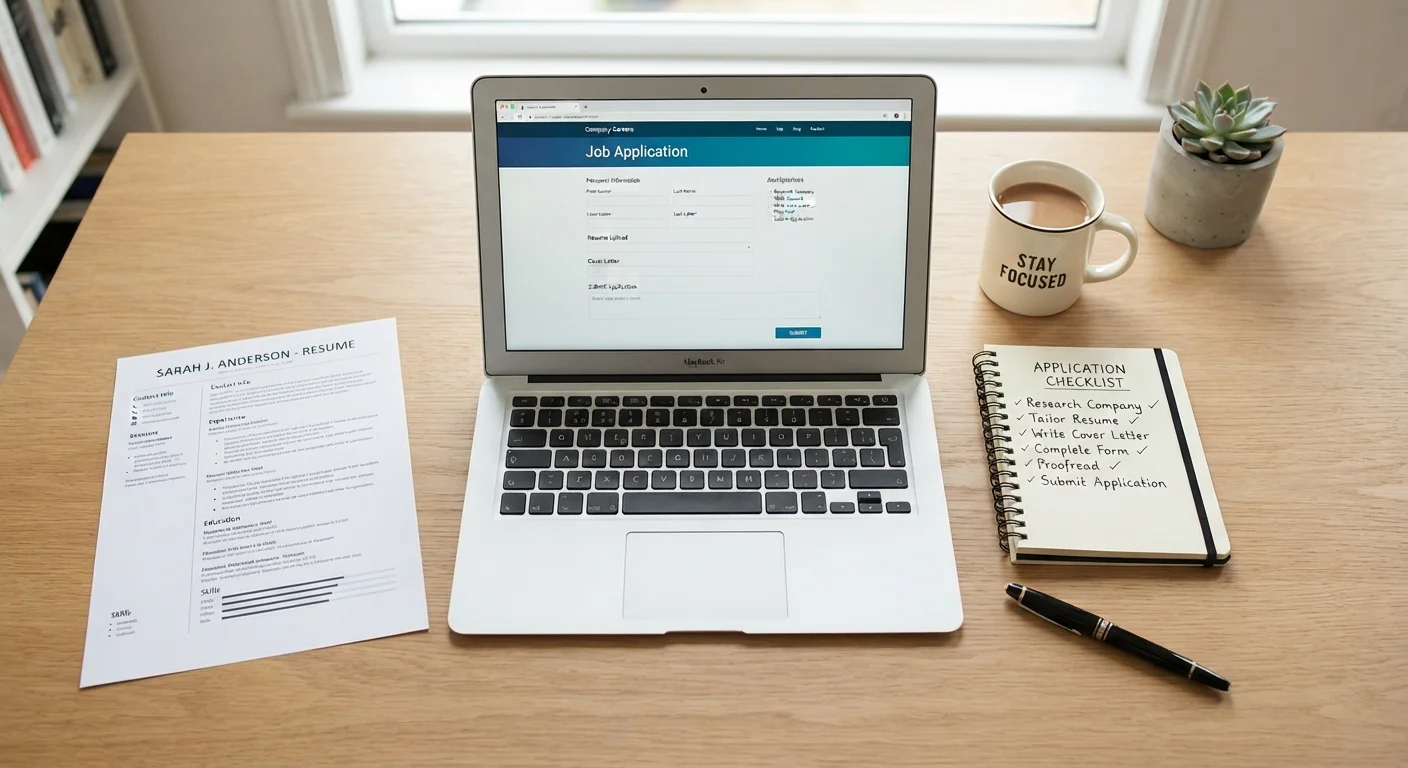
Before the interview, make sure your application is solid. See the application readiness checklist for a practical review of your resume, cover letter, and online profiles.
Job description printout or saved copy
Annotate required skills and map your experience directly against what the employer listed.
Company's website and press releases
Understand the organization's current priorities, products, and public positioning.
LinkedIn company profile
Review the interviewer's background and identify shared professional context.
Notepad or structured prep document
Record key talking points, prepared stories, and questions to ask the interviewer.
Step-by-step interview preparation
The steps below move in sequence from pre-interview research through post-interview follow-up. Each builds on the one before it. Skipping the early steps makes the later ones harder to execute well.
What you will need
Annotate the job description before anything else
Print or save the job description and read it slowly. Circle every skill, tool, and responsibility listed. Then mark each one with one of three labels: skills you have directly, skills you have partially, and skills you lack. This honest map tells you where to focus your preparation time and where to prepare bridging statements that show your capacity to learn.
Research the company beyond its homepage
Check recent news about the company, not just the About page. Search for press coverage, earnings reports if the company is public, or leadership commentary from the past year. Look at the company's social media for tone and culture signals. If the role touches a specific department, search for any public statements from that team's leadership. The goal is to understand what problems the organization is trying to solve right now, so your answers can speak to current needs rather than generic ones.
Build behavioral answers using the STAR structure
Most competency-based questions follow a pattern: tell me about a time when... The STAR structure (Situation, Task, Action, Result) gives your answer a clear shape without making it sound scripted. For each core skill in the job description, prepare one concrete story. Keep the Situation and Task brief; spend most of your time on the specific Actions you took and the measurable or observable Result. Avoid stories where the result was entirely a team effort with no clear individual contribution from you.
Prepare a framework for unexpected questions
No preparation covers every question. Instead of memorizing answers to lists of possible prompts, build a mental framework. When you receive an unfamiliar question, pause and identify what the interviewer is actually trying to learn: your judgment, your priorities, your self-awareness, or your approach to ambiguity. Then answer that underlying question using a real example or a direct statement of how you think. Silence for a few seconds while you gather your thoughts reads as composure, not confusion.
Prepare your own questions for the interviewer
Bring at least four questions, because some will be answered before you can ask them. Good questions target specifics: what does success look like in the first ninety days, what are the team's current priorities, or how has the role evolved over the past year. Avoid questions answered on the company's public website, which signals that you did not research. Avoid questions about salary or benefits in an early-round interview unless the interviewer raises them first.
Practice active listening during the interview itself
Preparation extends into the room. Listen to each question in full before forming your answer. Interviewers notice when a candidate starts answering the question they expected rather than the one actually asked. If you are unsure what is being asked, paraphrase it back: 'Are you asking about X, or more about Y?' That behavior shows clarity of thinking. Watch for nonverbal cues from the interviewer: if they lean forward or nod, you are on the right track; if they glance down, consider wrapping up that point.
Send a targeted follow-up email within 24 hours
A follow-up email is not a formality. Use it to reference one specific topic from the conversation, restate why the role fits your background, and note anything brief you wanted to add but did not get the chance to say. Keep it to three or four sentences. Sending a generic thank-you note adds little; tying your message to a real moment from the interview shows attention and follow-through, both of which reinforce the impression you made in the room.
Handling nerves and reading the room
Interview anxiety is normal and does not have to derail your performance. Physiological arousal before a high-stakes conversation is the same mechanism your body uses for any demanding task; what changes is how you interpret it. Treating the feeling as readiness rather than fear tends to produce steadier performance than trying to suppress it entirely.
Reading the room during the interview matters as much as what you say. A formal interviewer using precise, structured questions likely expects the same in return. A more conversational tone usually signals that cultural fit and interpersonal style are part of the evaluation. Adjust without abandoning the substance of your answers.
The same listening and presence skills that help in interviews transfer to other high-stakes workplace conversations. The guide on preparing for difficult conversations with coworkers covers related techniques for planning and tone management.
After the offer: what preparation looks like next
If the interview leads to an offer, your preparation work is not finished. Understanding how to evaluate and negotiate compensation is a separate skill. The groundwork for salary negotiation article covers the research and framing involved in making a compensation request that holds up under scrutiny.
Strong interview performance also connects to broader career-building habits. Once you are in a role, the feedback you get from managers and colleagues shapes how you grow. The guide on getting useful feedback during performance reviews can help you turn that process into something concrete.