

Why minimum payments feel manageable but are not
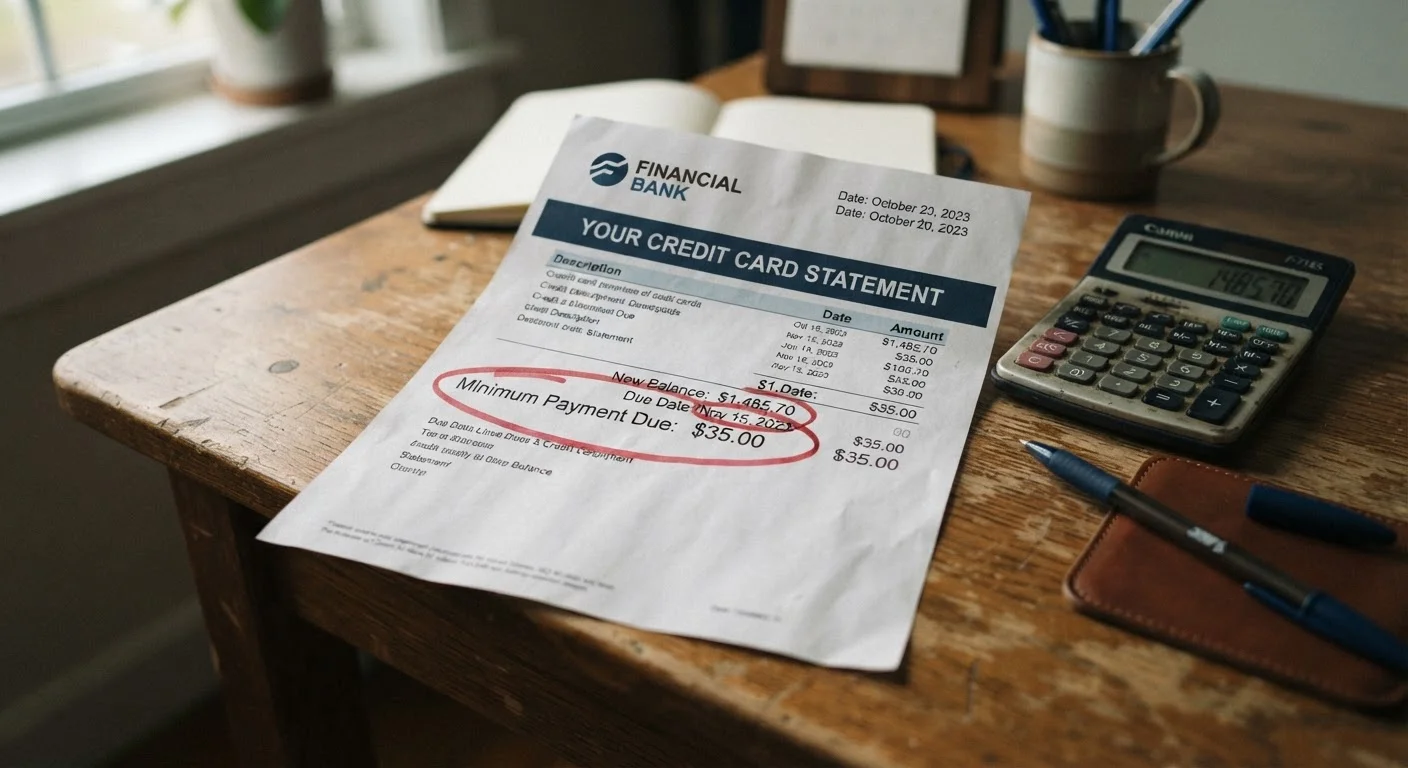
Credit card statements are designed to make the minimum payment stand out. It is a small number, it fits the budget, and paying it satisfies the requirement for another month. The problem is in what happens to the rest of the balance.
When you carry a balance at an annual percentage rate (APR) of, say, 22%, roughly 1.83% of your outstanding balance accrues as interest charges each month. On a $4,000 balance, that is about $73 in interest in one billing cycle. A minimum payment of around $80 at a typical 2% floor would leave only $7 reducing your principal. At that pace, the balance shrinks so slowly that the repayment period extends for years, and interest charges accumulate far beyond the original purchase price.
To understand why this happens mechanically, it helps to read our article on how compound interest works on debt. The same force that grows a savings account works against you when you carry a revolving balance.
What the numbers actually look like
Consider a concrete scenario. A cardholder carries a $4,000 balance at 22% APR and pays only the minimum each month (calculated as 2% of the balance or $25, whichever is greater). The minimum falls as the balance falls, so each subsequent payment is slightly smaller than the one before. Under this structure, paying off the full balance takes roughly 19 years and costs more than $5,000 in interest alone. The total amount paid exceeds $9,000 on a $4,000 debt.
22%+
Average credit card APR in the U.S.
Federal Reserve data has shown average credit card interest rates above 20% for new accounts, making carry costs among the highest in consumer lending.
$5,000+
Interest on a $4,000 balance at 22% APR (minimum payments only)
Illustrative calculation based on a 2% minimum payment floor; actual results vary by issuer formula and whether new charges are added.
19 years
Estimated payoff time on $4,000 at 22% APR (minimum payments only)
Illustrative estimate assuming no new purchases; paying a fixed $150 per month instead reduces this to approximately 3 years.
Now apply a fixed payment instead. If the same cardholder commits to a fixed $150 per month, the balance is clear in about 3 years and total interest paid drops to around $1,100. That is a difference of more than $3,900 in interest and 16 years of monthly payments, for a commitment of roughly $70 more per month than the initial minimum.
These figures are illustrative. Actual results depend on your APR, whether you add new charges to the card, and how your issuer calculates the minimum. A card issuer's online payoff calculator or a general-purpose amortization tool can show you the math for your specific balance and rate.
How the minimum shrinks as the balance shrinks
One detail that makes minimum-only repayment especially slow is that percentage-based minimums decrease automatically as the balance decreases. If your required payment was $80 on a $4,000 balance, it may be only $55 on a $2,700 balance. Cardholders who adjust their payment downward in step with the minimum extend their own repayment timeline without realizing it.
A straightforward fix is to treat the first month's minimum as the new floor and keep paying that fixed amount every month regardless of what the statement says. Alternatively, choosing a fixed target dollar amount that exceeds the initial minimum and automating it removes the decision entirely. See our guide on automating debt payments for practical steps on setting this up.
Set a fixed payment, not a minimum one
When you automate your credit card payment, choose a fixed dollar amount rather than the statement minimum. As your balance falls, the minimum will fall too, but your fixed amount will keep reducing principal at a steady pace. Even setting the autopay to $20 above the current minimum is a meaningful step.
Budget alignment matters too. If minimum payments compete with other fixed obligations, reviewing where spending is creeping upward can free room. Budget drift describes how small, recurring overages add up and reduce the money available for debt repayment.
Strategies to pay down the balance faster
No single approach fits every household. The options below reflect common debt-reduction methods; a qualified financial adviser can help you assess which fits your situation.
- Fixed payment above the minimum: Pick an amount you can sustain, set it as an automatic payment, and keep it constant regardless of balance changes.
- Rounding up: If your minimum is $67, pay $100. The difference feels small month to month but compounds over the repayment period.
- Applying windfalls: Tax refunds, bonuses, or irregular income directed to the balance reduce principal in a lump and lower future interest charges immediately.
- Prioritizing by rate: If you carry balances on multiple cards, concentrating extra payments on the highest-rate card first (sometimes called the avalanche method) minimizes total interest paid.
Whatever method you use, tracking progress matters. Seeing the balance fall each month reinforces the habit, which makes sustained repayment more likely.
This article is for general informational and educational purposes only and does not constitute personalized financial or legal advice. Consult a licensed financial professional regarding your specific circumstances.


