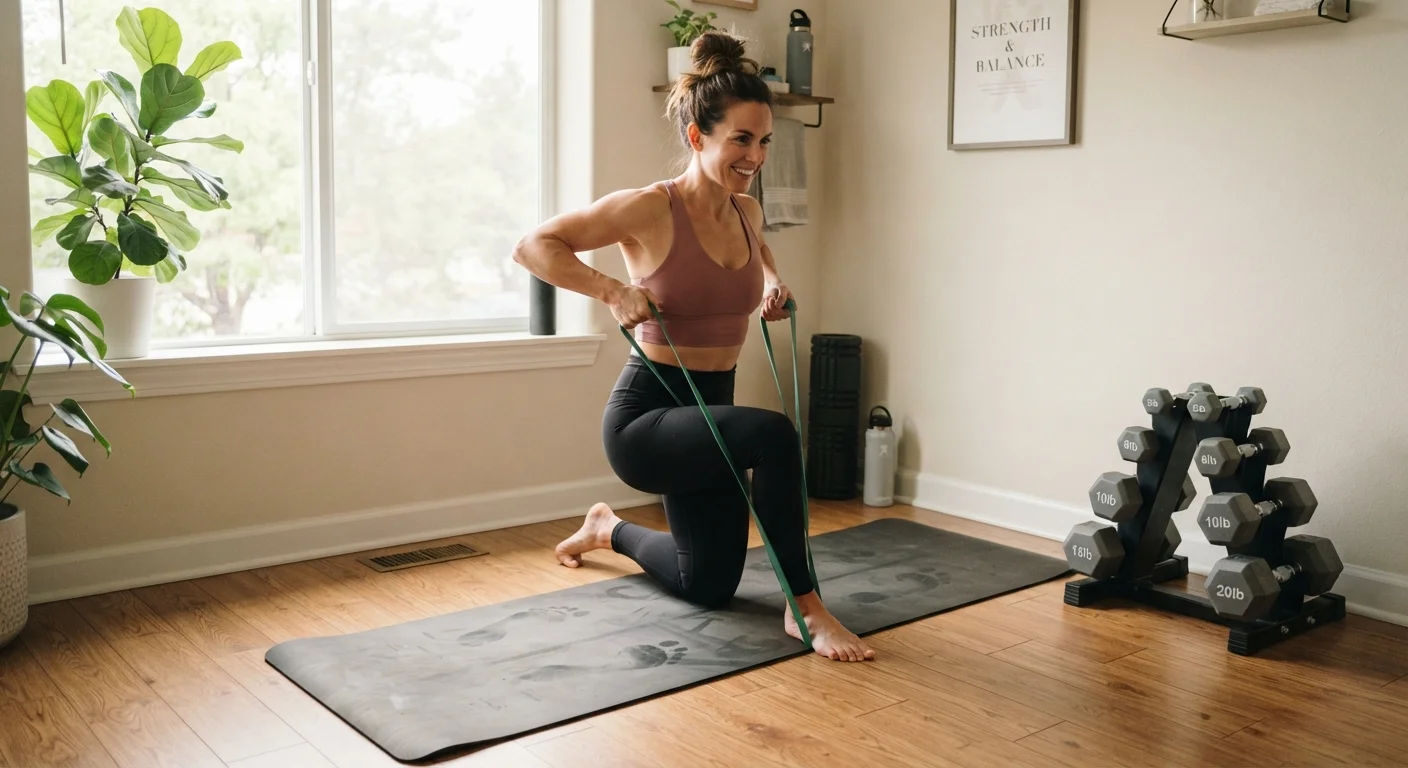

Why strength training matters for beginners
Strength training, also called resistance training, is the practice of working muscles against an opposing force to build muscular strength and endurance. That force can come from free weights, machines, resistance bands, or your own body weight.
The benefits extend well beyond appearance. Regular resistance training supports bone density, improves insulin sensitivity, and helps maintain a healthy body weight. According to the American College of Sports Medicine, it also contributes to better balance and functional movement, which matters for everyday tasks at any age.
Many beginners assume strength training is for athletes or people who already look fit. It is not. The physiological adaptations it produces are available to adults regardless of starting point, age, or athletic background. The first few weeks of training tend to produce the fastest relative gains in strength, because your nervous system adapts quickly even before significant muscle tissue is added.
Key concepts before you lift
A small amount of vocabulary makes it much easier to follow programs and understand what your body is doing.
Rep (repetition)
One complete cycle of a movement, such as lowering and raising a dumbbell once. Reps are counted to measure the volume of work in a set.
Set
A group of consecutive reps performed without stopping to rest. A common beginner target is three sets of ten reps per exercise.
Progressive overload
The practice of gradually increasing the demands placed on your muscles over time, usually by adding weight or reps, so the body continues to adapt and grow stronger.
Compound exercise
A movement that works more than one muscle group at the same time, such as a squat or push-up. Compound exercises are time-efficient and form the backbone of most beginner programs.
Rest interval
The time you take to recover between sets. Beginners typically rest sixty to ninety seconds, long enough to perform the next set with good form.
1-rep max (1RM)
The maximum weight you can lift for exactly one rep of an exercise with good form. Beginners rarely test this directly; it is used as a reference point in more advanced programming.
Understanding these terms lets you read any beginner program and know what is actually being asked of you, without needing a trainer to translate.
Form fundamentals: the movements that matter most
Beginners get the most value from a small group of compound movements, exercises that work multiple muscle groups at once. These produce more overall stimulus per session and teach your body to move as an integrated unit.
- Squat pattern: Bodyweight squats, goblet squats, or barbell back squats train your quads, glutes, and core together.
- Hip hinge pattern: Romanian deadlifts or conventional deadlifts build the posterior chain, including hamstrings, glutes, and lower back.
- Push pattern: Push-ups or a bench press train the chest, shoulders, and triceps.
- Pull pattern: Rows and lat pulldowns train the upper back and biceps, muscles many beginners neglect.
For each movement, prioritize a neutral spine, controlled breathing, and a full range of motion over the amount of weight on the bar. Poor form under load increases injury risk considerably. The most common training injuries in beginners are often linked to progressing weight before movement quality is solid.
Consider a few sessions with a trainer
If you are new to the gym, even two or three sessions with a certified personal trainer can establish good movement habits that prevent problems later. Look for a trainer with credentials from a recognized organization such as NSCA, ACSM, or NASM. Many gyms include an introductory session with membership.
Building your first program
A beginner program does not need to be complex. A full-body routine performed two to three times per week covers the major movement patterns and gives adequate recovery time between sessions.
A simple structure to follow:
- Warm up for five to ten minutes with light movement and dynamic stretching.
- Choose one exercise from each movement category (squat, hinge, push, pull).
- Perform two to three sets of eight to twelve repetitions per exercise.
- Rest sixty to ninety seconds between sets.
- Cool down with light stretching focused on the muscles worked.
Choosing a weight that feels challenging by the last two reps of a set, but does not compromise your form, is a reasonable guide. If you can complete all reps with ease, the load is probably too light. If form breaks down mid-set, it is too heavy.
For planning your training week alongside recovery and other habits, the weekly fitness planning checklist offers a practical structure.
Progressing safely over time
Progressive overload is the principle that muscles adapt to a given stress level and require a new challenge to continue growing. In practice, this means gradually increasing load, repetitions, or sets over weeks and months.
A simple progression approach for beginners: once you can complete all sets and reps in a workout with good form, add a small amount of weight (commonly two to five pounds for upper body, five pounds for lower body) the following session. This measured approach reduces injury risk compared to making large jumps.
Recovery is part of training, not separate from it. Muscle tissue repairs and grows during rest, not during the workout itself. Sleeping seven to nine hours per night and taking at least one rest day between strength sessions supports that process.
If you experience sharp or persistent pain during or after training, stop the exercise and consult a healthcare provider before continuing. Soreness in the days after a session is normal; pain during a movement is a signal worth heeding.
This article is for general informational purposes only and is not medical advice. Consult a qualified healthcare provider before starting a new exercise program, particularly if you have existing health conditions or have been inactive for an extended period.