
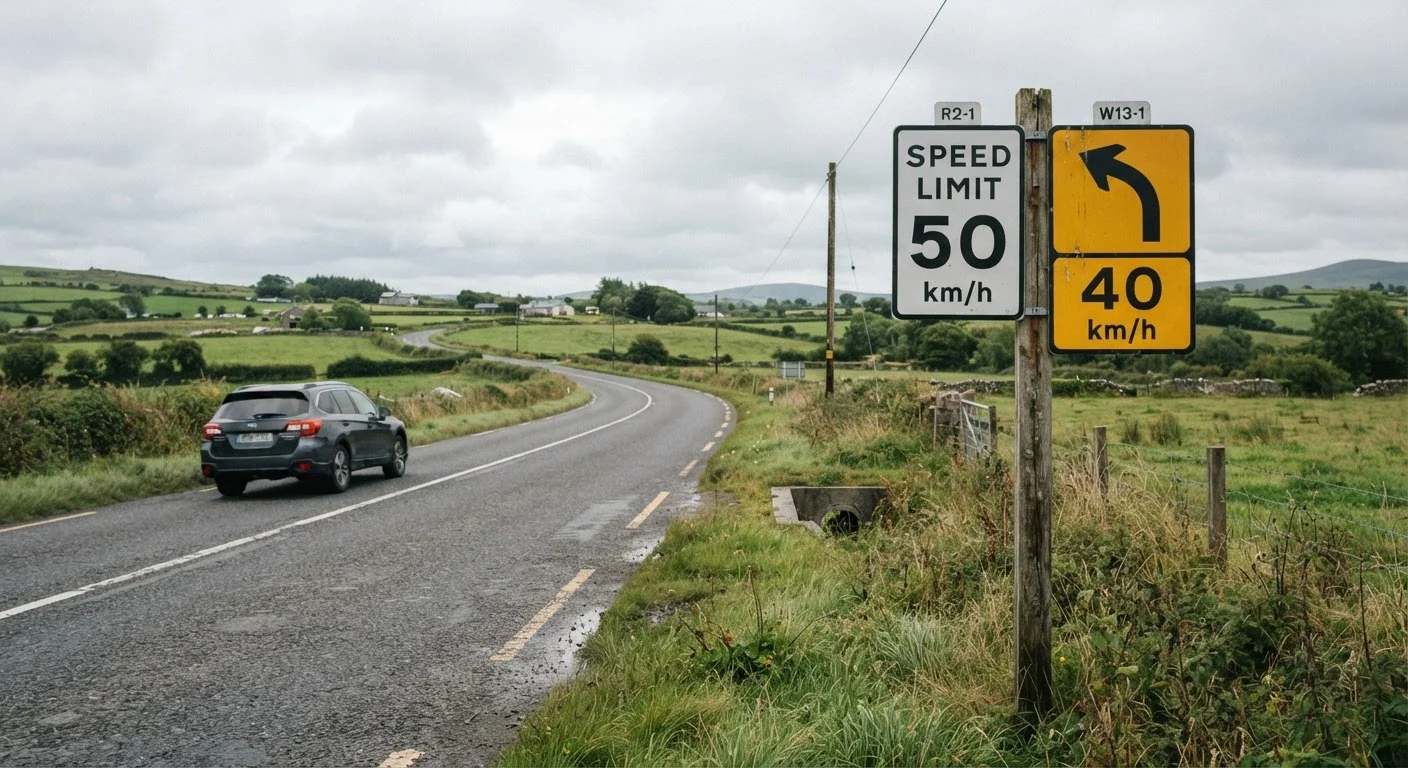
Two types of speed signs, one important distinction
Most drivers treat every speed limit sign the same way: a number on a post they should not exceed. That assumption is mostly right, but it misses a meaningful legal and safety distinction that affects how you should respond in practice.
Speed limit signs in the United States fall into two broad categories. Regulatory speed limits are the legally enforceable maximums set by state or local authority. Advisory speed signs are recommendations tied to a specific road feature, such as a curve, ramp, or intersection. Reading both correctly changes how you respond to each one.
Regulatory speed limits: the legal maximum
A regulatory speed limit is posted on a white rectangular sign with black numerals. Driving above that number is a traffic violation subject to citation. These limits are established through formal rulemaking by state transportation agencies or local governments and carry the force of law.
Regulatory limits come in two forms. A statutory speed limit is the default maximum that applies statewide on a class of road even when no sign is posted. For example, many states set a default 25 mph in residential areas and 55 mph on undivided rural highways. A posted regulatory limit overrides the statutory default and must be displayed on a sign.
One important nuance: a regulatory limit is the legal maximum under ideal conditions, not a target. Traffic, weather, visibility, and road surface all affect what constitutes a safe speed below that maximum. Officers can issue citations for driving at the posted limit when conditions make that speed unsafe, a doctrine sometimes called the basic speed law.
For more on how road type affects safe speed choices, see how following distance and speed interact on rural versus city roads.
Advisory speed signs: a recommendation, not a law
Advisory speed signs are yellow with black numerals. Yellow is the standard color for warning signs in the United States, and advisory speed signs are a subcategory of warning signs. They typically appear below a curve or turn warning symbol, or alongside a directional arrow indicating a specific alignment change ahead.
An advisory speed is the speed at which an engineering study determined a typical passenger vehicle can safely navigate that specific feature under normal conditions. It is not a legal limit. Driving above an advisory speed is not itself a violation, but if a crash occurs at or above that speed, it can be used as evidence that the driver was traveling faster than was reasonable for the conditions.
In practice, advisory speeds deserve more caution than many drivers give them. They are calculated for dry pavement and a standard vehicle. Rain, ice, a loaded truck, worn tires, or an unfamiliar road all reduce the margin between the advisory speed and the point where a driver loses control.
Regulatory speed limit
A legally enforceable maximum speed established by state or local authority and posted on a white rectangular sign. Exceeding it is a traffic violation.
Advisory speed
A recommended speed for a specific road feature such as a curve or ramp, displayed on a yellow warning sign. It is not a legal limit but reflects an engineering-based safety threshold.
Statutory speed limit
A default speed maximum set by state law that applies to a class of road even without a posted sign, such as 25 mph in residential areas.
Basic speed law
A legal principle present in most U.S. states holding that drivers must travel at a speed reasonable for current conditions, regardless of the posted limit.
Variable speed limit
An electronically displayed regulatory speed limit that changes in response to traffic volume, weather, or road incidents. It carries the same legal weight as a fixed posted limit.
How to respond to each sign type
When you see a white regulatory sign, treat it as the ceiling for normal conditions and adjust downward when conditions warrant. When you see a yellow advisory sign, treat it as a calibrated warning for that specific feature. Slow to the advisory speed or below before entering the curve or ramp, not while you are already in it.
A common error drivers make is decelerating inside a curve rather than before it. If a yellow curve sign shows 35 mph, the intent is that you reach 35 mph (or less) by the time the curve begins. Braking mid-curve shifts weight and reduces tire grip at the moment you need it most.
Variable speed limits, which appear on some interstate corridors and use electronic signs, are regulatory limits that change based on traffic or weather conditions. These have the same legal weight as fixed posted limits even though the number changes.
School zone limits and work zone limits are also regulatory. Reduced-speed school zone signs are often accompanied by flashing lights or time-of-day language that specifies when the lower limit applies. Penalties for violations in work zones are elevated in most states, and the limits remain in effect for the posted zone length regardless of whether workers are visible.