Why the air filter matters more than most drivers realize
Every internal combustion engine needs a precise mixture of air and fuel to run. The engine air filter is the only barrier between outside air and the intake manifold, and its job is to trap dust, pollen, insects, and road debris before they reach sensitive components. When that filter becomes clogged, the engine receives less air than it needs, and the fuel management system compensates by running a richer mixture. The result is higher fuel consumption for the same amount of output.
The U.S. Department of Energy has noted that a clogged air filter can reduce fuel economy on older carbureted vehicles significantly, and while modern fuel-injected engines manage the air-fuel ratio more precisely, restricted airflow still affects performance and efficiency. Drivers often attribute sluggish acceleration or a slight uptick at the pump to other causes without ever opening the airbox.
For a broader look at how skipping individual maintenance items compounds into larger problems, see what happens when engine maintenance is deferred.
The most common air filter mistakes
Waiting for a visible problem before checking the filter.
Why it happens: Engine air filters are out of sight under the hood, so most drivers never think about them between oil changes unless a mechanic brings it up.
Assuming the factory maintenance schedule applies regardless of driving conditions.
Why it happens: Owner's manuals publish a single interval, and many drivers treat it as universal without considering that gravel roads, construction zones, and rural areas load a filter much faster than highway commuting does.
Confusing the engine air filter with the cabin air filter and skipping one.
Why it happens: Modern vehicles have two separate filters: one that cleans air entering the engine and one that cleans air entering the passenger cabin. Drivers who know about one often assume they have checked both.
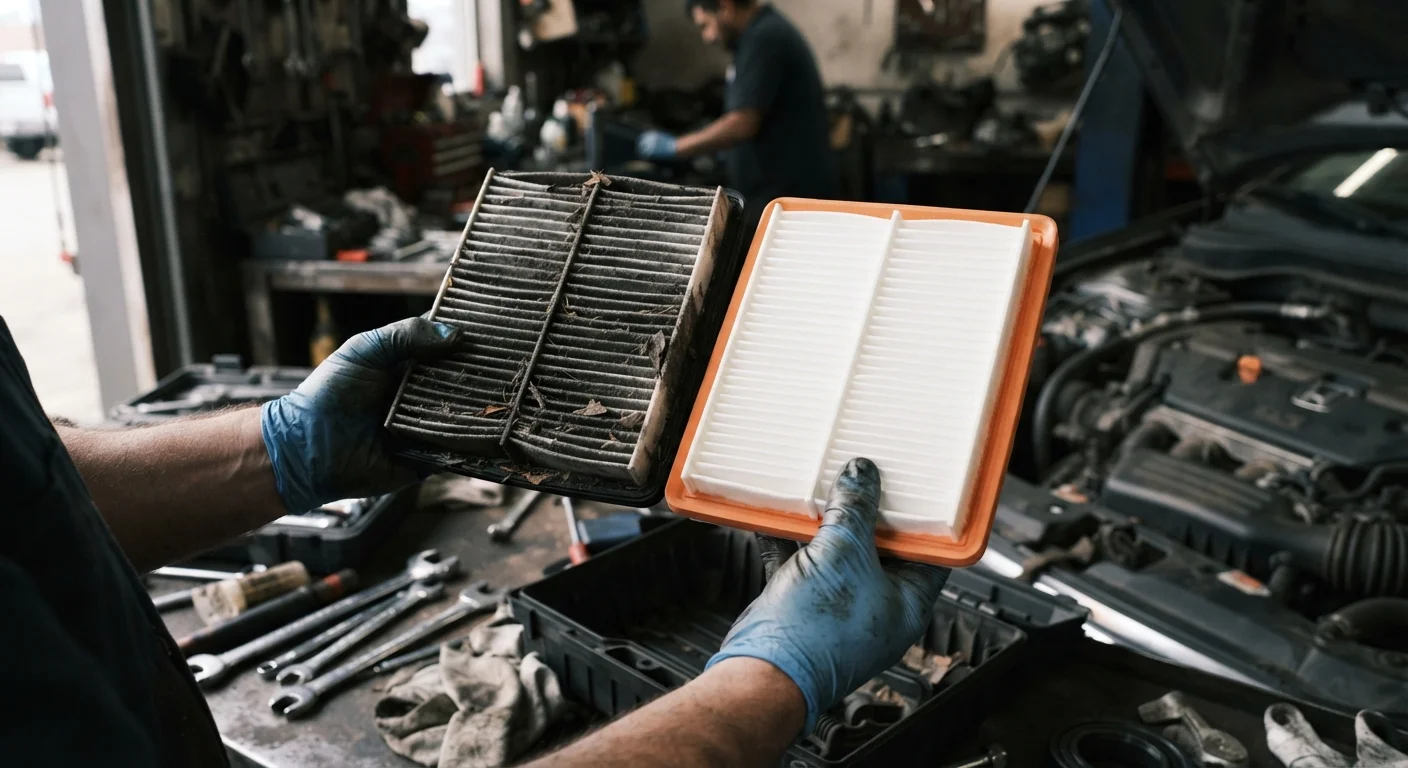
Tapping or blowing out a clogged filter and reinstalling it.
Why it happens: It seems like a reasonable shortcut: knock the loose debris out and reuse the part. Some online guides still recommend this as a money-saving step.
Ignoring a check engine light that has a mass airflow sensor code.
Why it happens: A check engine light triggers anxiety about expensive repairs, so some drivers delay investigating it, hoping it clears on its own.
Air filter errors rarely cause an immediate breakdown, which is part of why they persist. The damage is gradual: slightly worse economy this month, a little more wear on intake components next year. Recognizing the pattern early keeps that trajectory from becoming a repair bill. For a full list of service intervals that belong on your maintenance calendar, the car maintenance intervals reference guide is a useful starting point.
Symptoms that suggest the filter is overdue
Several signs point to a restricted air filter before a mechanic ever inspects it. Reduced throttle response when pulling onto a highway is one of the clearest, because the engine cannot draw the air volume it needs quickly enough. A rough idle, where the engine feels unsteady at a stoplight, can also result from an air-fuel imbalance caused by restricted intake flow.
Fuel economy that has gradually worsened over several fill-ups without a change in driving habits is worth investigating. A check engine light with a mass airflow sensor code is another signal, since a contaminated MAF sensor is sometimes a downstream consequence of a failing filter. Issues like poor fuel economy overlap with other maintenance needs too: worn ignition components can produce similar symptoms, as covered in our guide to spark plugs and ignition system maintenance.
Do not mistake engine and cabin filters
Many service advisors will offer to replace the cabin air filter during an oil change visit, which some drivers confuse with the engine air filter. They are separate parts with separate functions. Replacing only one while assuming the other is covered is a common oversight. Verify which filter is being serviced and ask about the other if it has not been inspected recently.