Why following distance is not one-size-fits-all
Most drivers learn the two-second rule during their early training: pick a fixed point, watch the car ahead pass it, and make sure two seconds elapse before you reach the same point. That rule is a reasonable starting point, but it was designed for average conditions at moderate speeds on roads with predictable hazards. Rural roads and city streets present very different conditions.
Speed, road surface, visibility, the presence of other road users, and the types of hazards that can appear without warning all vary dramatically between environments. A following distance adequate at 25 mph in stop-and-go traffic is dangerously short on a 55 mph two-lane country road. Treating both situations identically is one of the more common errors even experienced drivers make. For a deeper look at why closing the gap at speed is so frequently fatal, see the physics behind tailgating.
Following distance on city streets
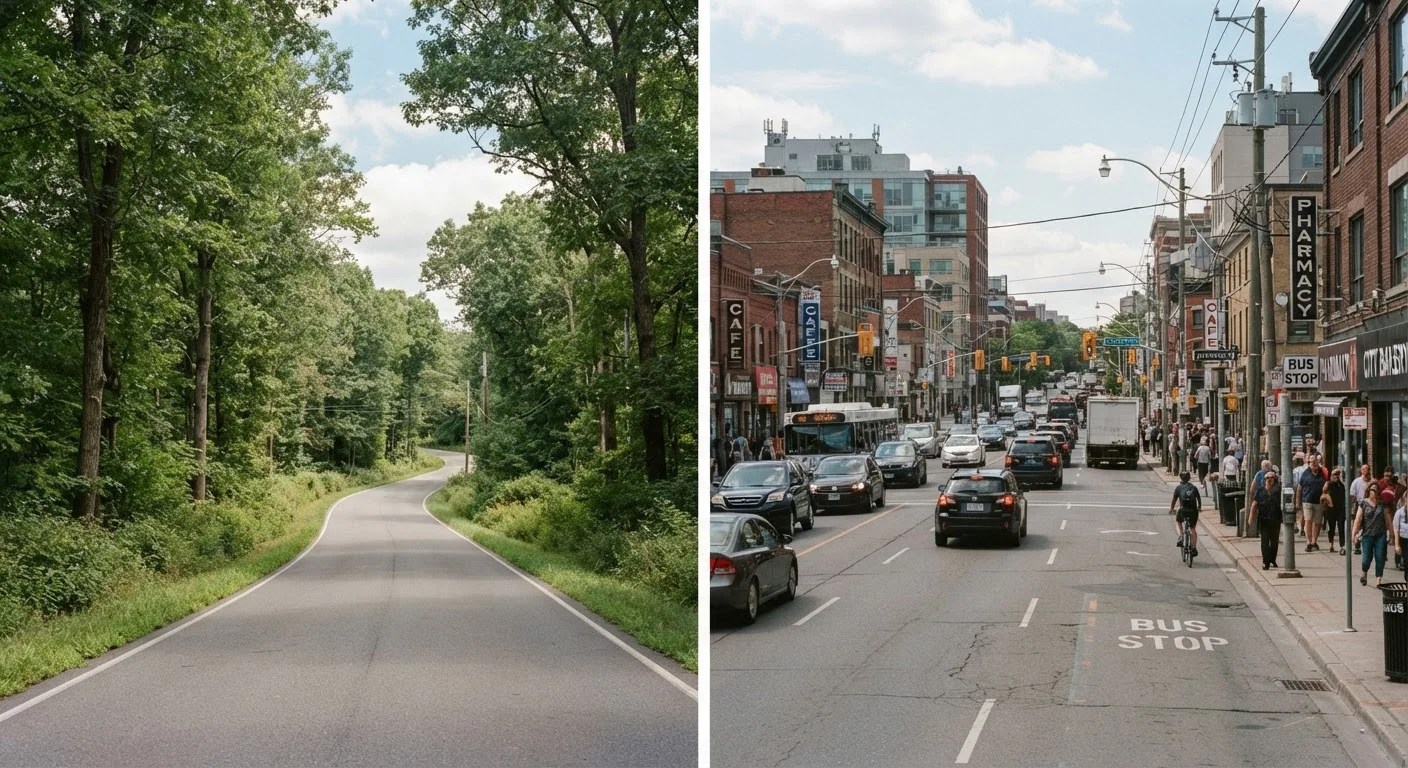
Urban driving is defined by density. Vehicles, cyclists, and pedestrians occupy the same compressed space, and the pace of change is fast. Signals change, delivery trucks stop mid-lane, and a pedestrian can step off a curb faster than a driver anticipating only other cars will react.
The two-second rule still applies as a floor, but city conditions require something different from the calculation: attentional coverage rather than just gap management. A driver two seconds behind a bus cannot see the crosswalk ahead of that bus. Dropping back slightly further improves sightlines without disrupting traffic flow.
Speed is lower in cities, which does reduce stopping distance. However, lower speed does not compress reaction time the same way. A driver glancing at a navigation screen for two seconds at 25 mph travels roughly 73 feet before looking up. At that distance, a child entering the road leaves almost no margin. Urban driving rewards a consistent scan pattern and eyes-on-road discipline at least as much as gap distance.
Use a visual anchor in city traffic
In heavy stop-and-go traffic, leaving a gap large enough to see the rear tires of the vehicle ahead touching the pavement is a practical way to judge minimum distance without relying on timing alone. This also leaves enough room to pull around a stopped vehicle if needed, without cutting into another lane abruptly.
In heavy stop-and-go traffic, leaving a gap large enough to see the rear tires of the vehicle ahead touching the pavement is a practical way to judge minimum distance without relying on timing alone.
Following distance on rural roads
Rural roads present a different problem. Speeds are higher, traffic is lighter, and that combination often produces a false sense of security. With fewer cars nearby, many drivers unconsciously close the gap, reasoning that there is little to hit. The hazards on rural roads are simply less visible, not less frequent.
Animals crossing the road, farm equipment moving at 15 mph, loose gravel from unpaved shoulders, and unexpected dips or frost heaves all require stopping or swerving with limited warning. At 55 mph, a vehicle travels about 80 feet per second. A deer entering the road 160 feet ahead gives a driver approximately two seconds to react and begin braking, and that assumes the driver is already alert.
Traffic engineers and safety researchers generally recommend a minimum of three seconds following distance on rural roads, with four or more seconds appropriate in low-light conditions, wet roads, or areas with known wildlife crossings. The distinction between posted and advisory speed limits is also relevant here: an advisory limit on a rural curve reflects the geometry of that curve, not just a legal threshold.
| City streets | Rural roads | |
|---|---|---|
| Typical speed range | 15 to 45 mph | 45 to 65+ mph |
| Minimum following distance (dry) | 2 seconds | 3 seconds |
| Primary hazard types | Pedestrians, cyclists, sudden stops | Animals, farm equipment, poor visibility |
| Visibility limitations | Large vehicles blocking crosswalks and signals | Curves, hills, darkness, no streetlights |
| Weather adjustment needed | Double gap in rain or snow | Triple gap in rain, ice, or fog |
| Key driver discipline | Scan pattern, short-range awareness | Speed management, alertness at distance |
Conditions that change the calculation in both environments
Rain, snow, and fog affect braking distance on any road type. Wet pavement can double stopping distance compared to dry conditions. That means a two-second gap on a dry city street may need to become four seconds in rain, and a three-second rural gap may need to become six or more on ice.
Fatigue is a compounding factor. Rural roads with limited stimulation increase drowsiness faster than urban roads, and a fatigued driver has slower reaction time regardless of following distance. On longer rural stretches, stopping to rest is a practical safety measure, not a preference.
Smooth, early braking on any road type also reduces the risk of a rear-end collision behind you. Braking habits that reduce vehicle wear overlap with the habits that give following drivers more warning. When you brake gradually and early, the driver behind you has time to react rather than being surprised by a sudden deceleration.
Transitional segments, where a city road becomes a county highway or a highway feeds into a town, require active adjustment. Drivers who set a gap appropriate for one environment and hold it through the transition are the ones most likely to be caught unprepared when conditions change. Recalibrate distance as speed and road character change.