What coolant actually does inside your engine
Gasoline engines generate enormous heat as a byproduct of combustion. Without a way to remove that heat, metal components would warp, seize, or fail within minutes of starting. Coolant is the medium that moves heat away from the engine block and cylinder head, carrying it through hoses to the radiator, where airflow pulls the heat out of the liquid before it cycles back.
Water alone conducts heat well, but it has two critical weaknesses: it boils at 212 degrees Fahrenheit and freezes at 32 degrees Fahrenheit. Ethylene glycol raises the boiling point and lowers the freezing point of the mixture, giving the fluid a functional range that covers nearly every climate a driver in the United States will encounter. The pressure cap on the radiator raises the system pressure, which pushes the boiling point even higher, typically above 250 degrees Fahrenheit.
Coolant also contains a package of corrosion inhibitors. The cooling system contains aluminum, cast iron, copper, and rubber. Without chemical protection, these materials corrode and shed particles that clog passages and degrade seals.
Winter freeze protection: how the math works
A standard 50/50 mixture of ethylene glycol coolant and water protects down to approximately -34 degrees Fahrenheit. Drivers in northern states can increase the concentration to about 70 percent coolant, which pushes protection to roughly -84 degrees Fahrenheit. Going beyond 70 percent is counterproductive: straight glycol actually freezes at a higher temperature than the properly diluted mixture and transfers heat less efficiently.
The freeze protection matters because water expands when it freezes. If coolant lines, the engine block's water jacket, or the radiator freeze solid, the expanding ice can crack the block or split a hose. That kind of damage is expensive and, in many cases, not worth repairing on an older vehicle. The same principle applies to household plumbing; the process for protecting outdoor pipes before a freeze follows similar logic about preventing expansion damage.
Use distilled water when mixing coolant
Most pre-mixed coolant sold at auto parts stores is already at a 50/50 ratio. If you buy concentrate, mix it with distilled water rather than tap water. Tap water contains minerals that accelerate corrosion inside the cooling system.
Most pre-mixed coolant sold at auto parts stores is already at a 50/50 ratio. If you buy concentrate, mix it with distilled water rather than tap water. Tap water contains minerals that accelerate corrosion inside the cooling system.
Signs the cooling system needs attention
The temperature gauge on the dashboard is the most direct indicator. A needle creeping into the red zone, or a warning light shaped like a thermometer, means the engine is running hotter than it should. Pull over safely and do not continue driving, as sustained overheating can cause head gasket failure or worse.
Less dramatic warning signs include a sweet smell coming from the engine bay, which suggests coolant is burning off somewhere it should not be. White smoke from the exhaust, especially on a warm engine after a cold start has passed, can indicate coolant entering the combustion chamber. Coolant that looks milky or has a brownish foam floating in the reservoir suggests oil contamination, a common symptom of a blown head gasket.
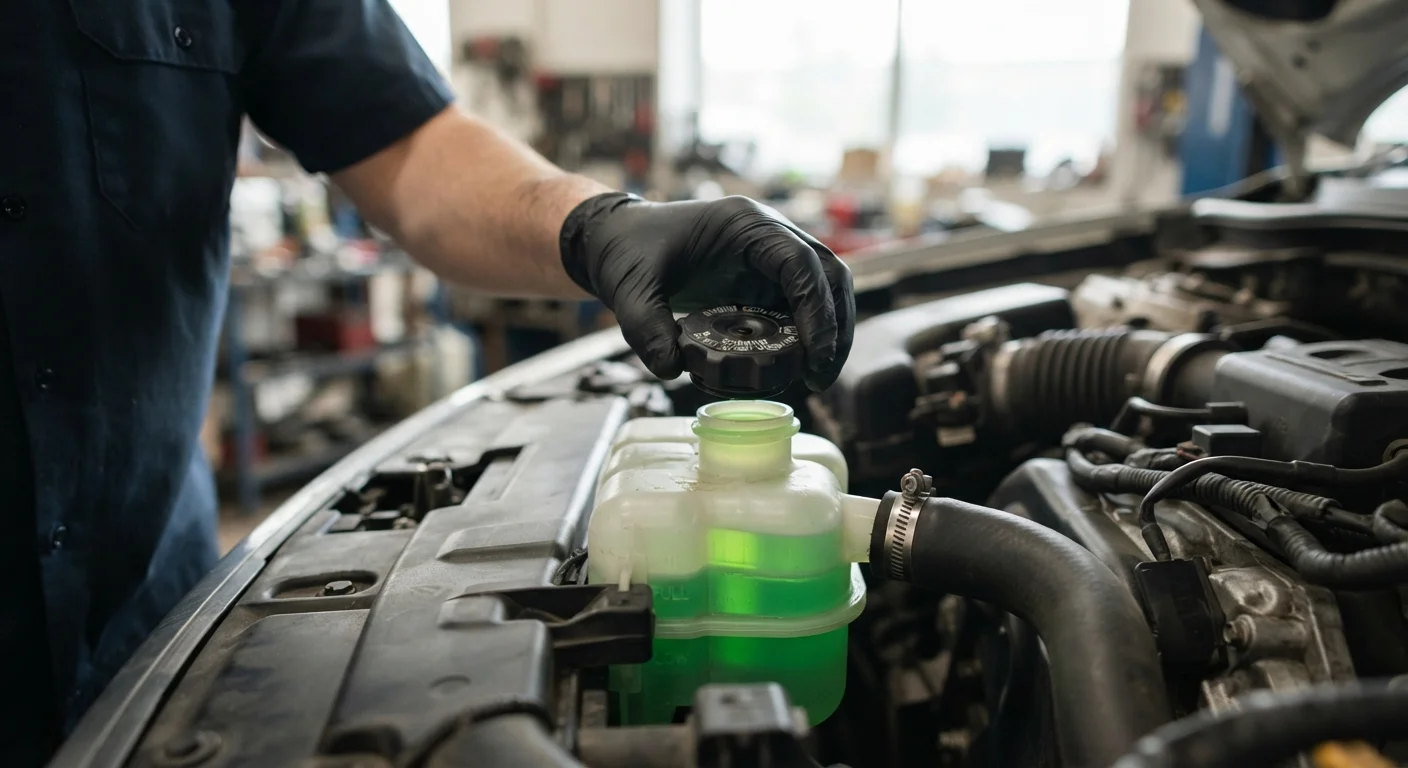
Low coolant level by itself does not always mean a major problem. Small amounts of loss through normal operation can occur over time. However, a reservoir that drops noticeably between checks warrants a pressure test by a qualified mechanic to find the source of the leak.
For a broader routine that covers coolant alongside oil, brake fluid, and other critical fluids, the car fluids check guide walks through each reservoir and what to look for.
Coolant flush: when and why
Over time, the corrosion inhibitors in coolant break down. The glycol itself also degrades and becomes acidic, which accelerates corrosion rather than preventing it. A flush removes degraded fluid and replaces it with fresh coolant that has a full complement of protective additives.
Most manufacturers recommend a flush every 30,000 to 50,000 miles, though some long-life coolant formulas are rated for up to 100,000 miles or five years. The owner's manual has the authoritative interval for a specific vehicle. A shop performing a flush will drain the old fluid, rinse the system, and refill with the correct coolant type and concentration.
Using the wrong coolant type is a common mistake. Green coolant (Inorganic Additive Technology, or IAT) is traditional and requires more frequent replacement. Orange, pink, and blue formulas typically use Organic Acid Technology (OAT) or a hybrid version (HOAT) and last longer. These formulas are not universally interchangeable. The owner's manual specifies which type the manufacturer tested and approved for that cooling system.