

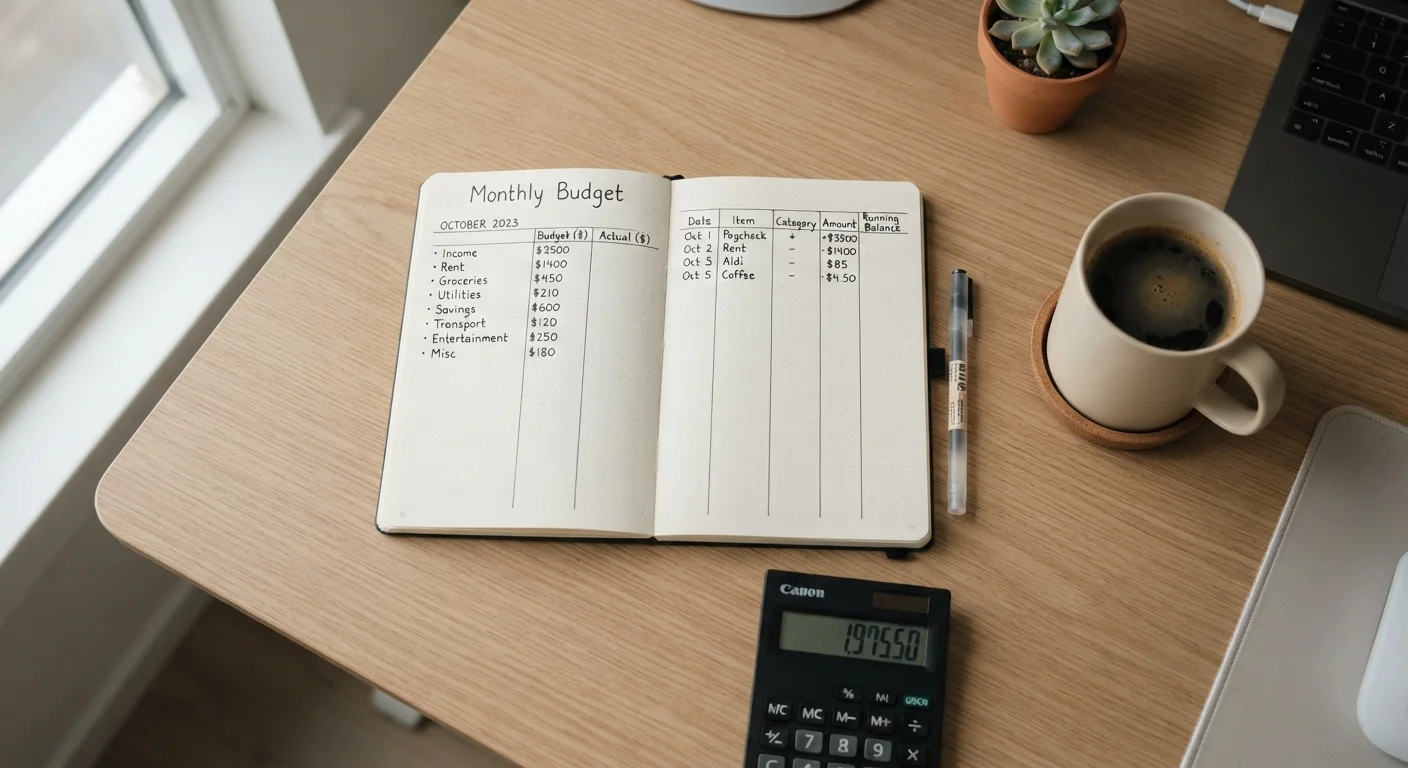
What a monthly budget actually is
A monthly budget is a plan. Specifically, it is a written allocation of your expected income across spending categories and savings before that income arrives or gets spent. You decide in advance how much goes to rent, groceries, utilities, debt payments, and savings. When the month unfolds, those decisions are already made.
That forward-looking structure is what separates a budget from a spending log. Logging what you spent last month tells you where money went. A budget tells money where to go. Both pieces of information matter, but only the budget changes what happens next.
A complete monthly budget accounts for every dollar you expect to receive and every dollar you expect to spend or save. If your take-home pay is $3,800 and your budget only covers $3,200 worth of categories, the remaining $600 is unplanned, which means it will likely disappear without serving any goal. A real budget closes that gap on paper before the month starts.
For a broader look at how budgeting fits into personal finance overall, see our complete budgeting overview.
What a monthly budget is not
A budget is not a punishment. It does not mean you stop spending on things you enjoy. It means you decide how much you will spend on those things before you spend it. That distinction changes the psychology considerably.
A budget is also not the same as a financial plan. A financial plan covers long-term goals: retirement savings strategy, insurance needs, investment allocation, estate considerations. A monthly budget is narrower. It manages cash flow within the current month. The two work together, but they are not interchangeable. If you want to understand the difference in depth, what a financial plan actually is explains what a full plan covers and why it extends well beyond monthly budgeting.
A budget is not a fixed document. It should change when your income, expenses, or priorities change. A budget built in January for a household with one income stream needs to be updated when a second income starts, when a car payment ends, or when a medical bill arrives.
Finally, a budget is not just for people in financial trouble. It is a standard tool for managing money regardless of income level or financial stability.
Start with one month of data
If you have never built a budget before, pull three months of bank and credit card statements and calculate what you actually spent in each category. Use those averages as your starting targets. Real numbers from your own life produce a more accurate budget than any template or rule of thumb.
The core components of a monthly budget
Every monthly budget, regardless of format, contains the same basic elements.
- Income: All expected take-home pay for the month, including wages, freelance income, side work, government benefits, or any other regular source. Use net income (after taxes), not gross.
- Fixed expenses: Costs that stay the same each month, such as rent or mortgage, car payments, and most insurance premiums.
- Variable expenses: Costs that fluctuate, such as groceries, gas, utilities, dining, and entertainment. These categories need an estimated cap.
- Savings and debt payoff: Money set aside for an emergency fund, retirement contributions, or extra debt payments. Treating savings as a line item rather than an afterthought is what makes a budget functional rather than cosmetic.
When you subtract all three expense groups from income, the result should be zero or a small planned surplus. An unplanned surplus means some spending is happening outside the budget. An unplanned deficit means the budget, as written, does not work and needs revision before the month begins.
If you want to see how these components get built from the ground up, building a realistic household budget from scratch walks through the full process.
~1 in 3
Americans who report having a detailed household budget
Gallup polling has consistently found that fewer than half of U.S. adults maintain a written or detailed household budget.
~$1,000
Median amount Americans say they could cover from savings for an emergency
Bankrate's annual emergency savings surveys have repeatedly found that a large share of U.S. adults could not cover a $1,000 unexpected expense from savings alone, illustrating why planned saving inside a budget matters.
Common budget methods and when they matter
The format of a budget matters far less than the habit of using one. Several approaches are in common use, and each suits different preferences.
The 50/30/20 method divides after-tax income into needs (50%), wants (30%), and savings or debt repayment (20%). It is flexible and requires minimal tracking once set up.
Zero-based budgeting assigns every dollar a specific category so that income minus all allocations equals zero. This method requires more time to maintain but leaves no money unaccounted for. If you are curious whether zero-based budgeting fits your habits, what zero-based budgeting actually requires each month covers the real demands of the method.
Envelope budgeting (or its digital equivalent) allocates cash to physical or virtual envelopes for each spending category. When an envelope is empty, spending in that category stops for the month.
All three methods do the same thing: they make spending decisions in advance and create a record against which actual spending can be compared.
One topic that belongs inside any budget conversation is emergency savings. A budget and an emergency fund are not the same thing, but they connect directly. how an emergency fund fits inside a monthly budget explains how to account for that savings goal within your spending plan.
This article is for general informational purposes only and does not constitute personalized financial advice. Consider consulting a qualified financial professional for guidance specific to your situation.


