The Greater Antilles: big islands, big variety
The Greater Antilles is the Caribbean's largest island group by land area and includes Cuba, Jamaica, Hispaniola (shared by Haiti and the Dominican Republic), and Puerto Rico. These islands are mountainous in the interior, with coastlines that shift from white sand to black volcanic rock depending on where you go.
For American travelers, Puerto Rico is the most logistically simple entry point. It is a US territory, so no passport is required, and flights from major US hubs are plentiful. The Dominican Republic draws travelers who want all-inclusive resorts concentrated along the north and east coasts, while Jamaica has a long-standing tourism infrastructure built around both beach towns and interior nature.
Cuba remains in a distinct legal and logistical category for US citizens; travel is permitted under specific license categories, and payment infrastructure is limited. Travelers interested in Cuba should verify current US Treasury Department guidelines before making plans.
The Greater Antilles generally offers more geographic scale than other Caribbean groups: waterfalls, coffee-growing highlands, colonial cities, and large national parks all exist within single islands. If you want land-based variety rather than just beach time, this group has that range.
The Lesser Antilles: the island-hopping arc
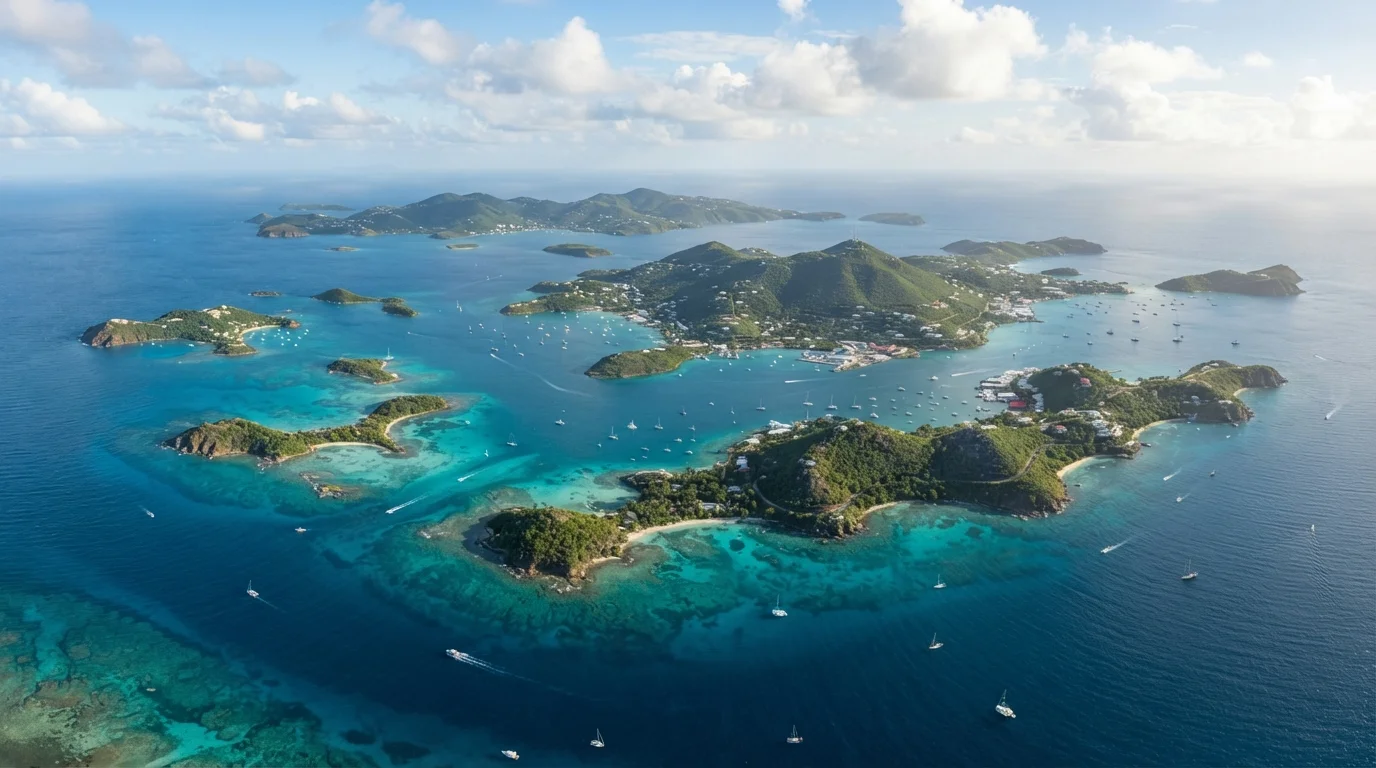
The Lesser Antilles curves from the US Virgin Islands in the north down to Trinidad and Tobago near the South American coast. It contains dozens of smaller islands and is divided by geographers into the Leeward Islands in the north and the Windward Islands in the south.
These islands are generally smaller, with steeper terrain in many cases and more concentrated beach or diving scenes rather than the sprawling overland routes of the Greater Antilles. The political map here is patchwork: some islands are independent nations (Barbados, St. Lucia, Grenada), while others remain overseas territories of France, the Netherlands, or the UK. That history shapes everything from the local language and cuisine to the currency you need on arrival.
Check currency and entry rules per island
Because the Lesser Antilles contains independent nations, French overseas departments, Dutch constituent countries, and British territories, entry rules and accepted currencies differ from island to island. Confirm what documentation and payment methods you need for each stop before you depart, using official government sources.
Island-hopping within the Lesser Antilles is a popular approach. Regional carriers connect many of these islands, and some ferry routes exist between neighboring pairs. Planning multi-island itineraries in this arc typically requires more layover research than travel within the Greater Antilles, so the difference between layovers and stopovers matters when booking regional flights here.
Aruba, Bonaire, and Curacao (the ABC Islands) sit off the Venezuelan coast and are technically part of the Lesser Antilles. They are drier and flatter than most Caribbean islands, with a desert scrubland interior and some of the clearest diving water in the region.
The Bahamas: Atlantic archipelago with Caribbean appeal
The Bahamas is an archipelago of about 700 islands and 2,400 cays spread across the Atlantic Ocean north of Cuba. Most visitors go to Nassau on New Providence island or to Paradise Island, but the Out Islands (also called the Family Islands) are much quieter and increasingly popular with travelers who want seclusion.
Because the Bahamas sits closer to Florida than any other Caribbean destination, it works well for short trips. Flight times from Miami can be under an hour. The terrain is flat compared to the volcanic islands of the Lesser Antilles, and the water is famously shallow in places, producing the electric-blue color visible in aerial photos.
700+
Islands and cays in the Bahamas archipelago
The Bahamas government estimates the archipelago contains about 700 islands and 2,400 cays, though only about 30 are inhabited.
4
Major islands in the Greater Antilles
Cuba, Jamaica, Hispaniola, and Puerto Rico make up the Greater Antilles, which together account for the majority of the Caribbean's total land area.
~28
Independent and dependent territories in the Lesser Antilles
The Lesser Antilles contains a mix of independent nations and overseas territories belonging to France, the Netherlands, the UK, and the US.
Unlike the US Virgin Islands or Puerto Rico, the Bahamas requires a passport for US citizens. Entry rules and tourist fees change periodically, so travelers should confirm current requirements with the Bahamas Ministry of Tourism or the US Department of State before travel.
The Bahamas is independent, with its own currency (the Bahamian dollar, which is pegged to the US dollar and widely interchangeable), though US dollars are generally accepted across most islands. For American travelers curious about a similarly fragmented coastal geography closer to home, the Gulf Coast's barrier islands offer a useful comparison in scale and character.
Choosing the right group for your trip
The three island groups suit different travel goals. Travelers who want a single base with enough terrain to fill a week or more tend to gravitate toward the Greater Antilles. Travelers drawn to island-hopping, diving, and mixing French, Dutch, and British cultural influences usually find the Lesser Antilles more satisfying. The Bahamas makes sense for short trips, water-focused itineraries, or travelers in Florida who want a quick international experience.
Budget considerations vary considerably. The Dominican Republic and Jamaica generally have lower accommodation costs than many Lesser Antilles islands, where small-island economies mean higher prices for imports including food. The Bahamas ranges widely depending on whether you stay in Nassau or head to the Out Islands, where logistics add cost.
Language is another practical factor. Spanish is the primary language on Cuba, the Dominican Republic, and Puerto Rico. English is standard in Jamaica, Barbados, the Bahamas, and the US and British Virgin Islands. French, Dutch, and Creole are all present across different parts of the Lesser Antilles.
Travelers who enjoy comparing regional geographic diversity might also find useful context in how Central America's countries differ from each other, since similar forces of colonial history and geography shape the travel experience across that region as well.