
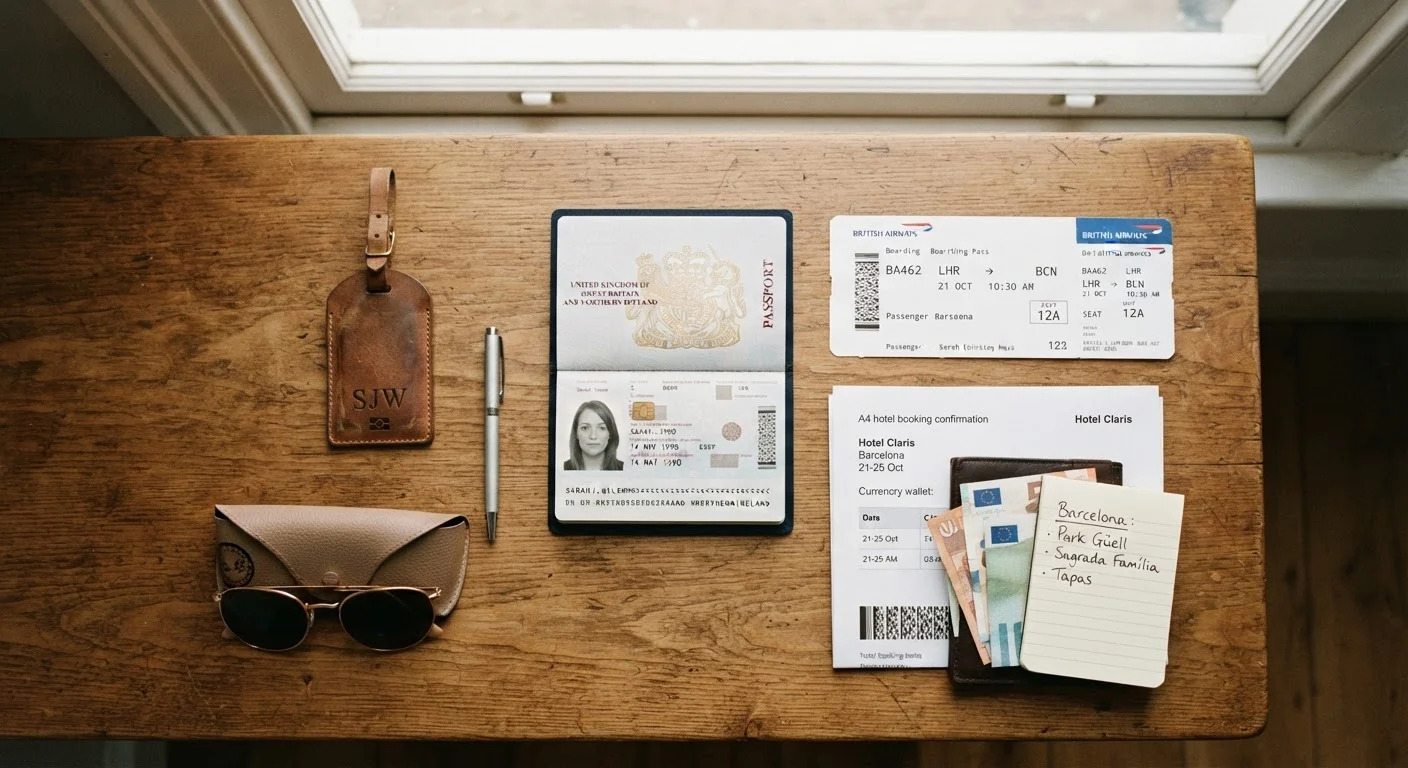
Why trip type determines your documents
A driver's license gets you through a domestic airport checkpoint. It will not get you onto a cruise departing for the Bahamas. The documents you need depend on where you are going, how you are getting there, and what border authorities along the way require. This guide breaks the most common U.S. trip types into clear categories so you can check what you need without wading through official policy documents.
Verification is always your responsibility. Entry rules change, and the details here are general guidance, not a substitute for checking official sources such as the U.S. Department of State, U.S. Customs and Border Protection, or your cruise or airline carrier before you travel.
Domestic flights within the United States
For adults 18 and older, the Transportation Security Administration (TSA) requires a REAL ID-compliant document or an acceptable alternative at airport security checkpoints. Acceptable documents include a REAL ID-compliant state driver's license or ID card, a U.S. passport, a U.S. passport card, a Department of Defense ID, or a permanent resident card, among others.
A standard state driver's license that is not REAL ID-compliant may not be accepted at TSA checkpoints, depending on your state's compliance status. Check whether your current ID carries the REAL ID star marking. If it does not, a U.S. passport works as a backup.
Children under 18 are not required to show ID for domestic flights, though airlines may have their own policies for unaccompanied minors. Confirm requirements directly with your carrier.
For general trip planning around domestic travel, see the first-timer's orientation to solo U.S. travel for broader logistics guidance.
Cruises: closed-loop and open-jaw sailings
Cruise documentation depends on whether your itinerary starts and ends at a U.S. port (called a closed-loop cruise) or departs from or arrives at a foreign port (open-jaw).
Closed-loop cruises: U.S. citizens can technically sail with a government-issued photo ID plus an original or certified copy of a birth certificate. However, a passport is strongly recommended. If a medical emergency requires you to fly home from a foreign port, you will need a passport to board that flight. Most travel professionals consider a passport essential for any cruise, regardless of the loop status.
Open-jaw cruises: A valid U.S. passport is required. If your itinerary includes stops in specific countries (for example, Cuba, certain Caribbean nations, or ports in Central America), additional visas or entry permits may be required. Check each country's requirements through the U.S. State Department's travel pages before you book.
Some cruise lines also ask for proof of travel insurance or a return ticket at embarkation. Confirm directly with your carrier what they require beyond passport control documentation.
International travel by air
A valid U.S. passport is the baseline requirement for international air travel. Your passport must generally be valid for at least six months beyond your intended return date, though the exact requirement varies by country. Many travelers have been turned away at the gate or denied entry because their passport expired within that window.
Beyond the passport, you may need one or more of the following:
- A tourist visa or electronic travel authorization (ETA), such as those required for Canada, Australia, and several European countries under their respective entry systems
- Proof of onward travel (a return or connecting ticket)
- Proof of sufficient funds for your stay
- Vaccination records for certain destinations, particularly those with yellow fever or other health entry requirements
For a full walkthrough of planning an international trip, the international trip planning guide covers passports, visas, and on-the-ground preparation in detail. Before you pack, the guide on traveling with medications addresses documentation for prescriptions crossing borders.
Always check entry requirements through both the U.S. State Department and the destination country's official immigration authority, since requirements can change with little notice.
Before you leave: documents and devices
Gather physical and digital copies of every document you are carrying. Store a scanned copy of your passport, visa, and any travel authorizations in a secure cloud folder you can access offline. Leave a physical copy with a trusted contact at home.
A pre-trip packing checklist can help you confirm documents are packed alongside medications, chargers, and other items easy to forget. If you plan to access digital copies abroad, the device prep checklist covers offline access, roaming settings, and backup strategies so your phone works reliably at your destination.
Apply for or renew your passport well ahead of your trip. Standard processing takes several weeks, and expedited processing during busy seasons can still take longer than advertised. The U.S. Department of State posts current processing times on its official website.