
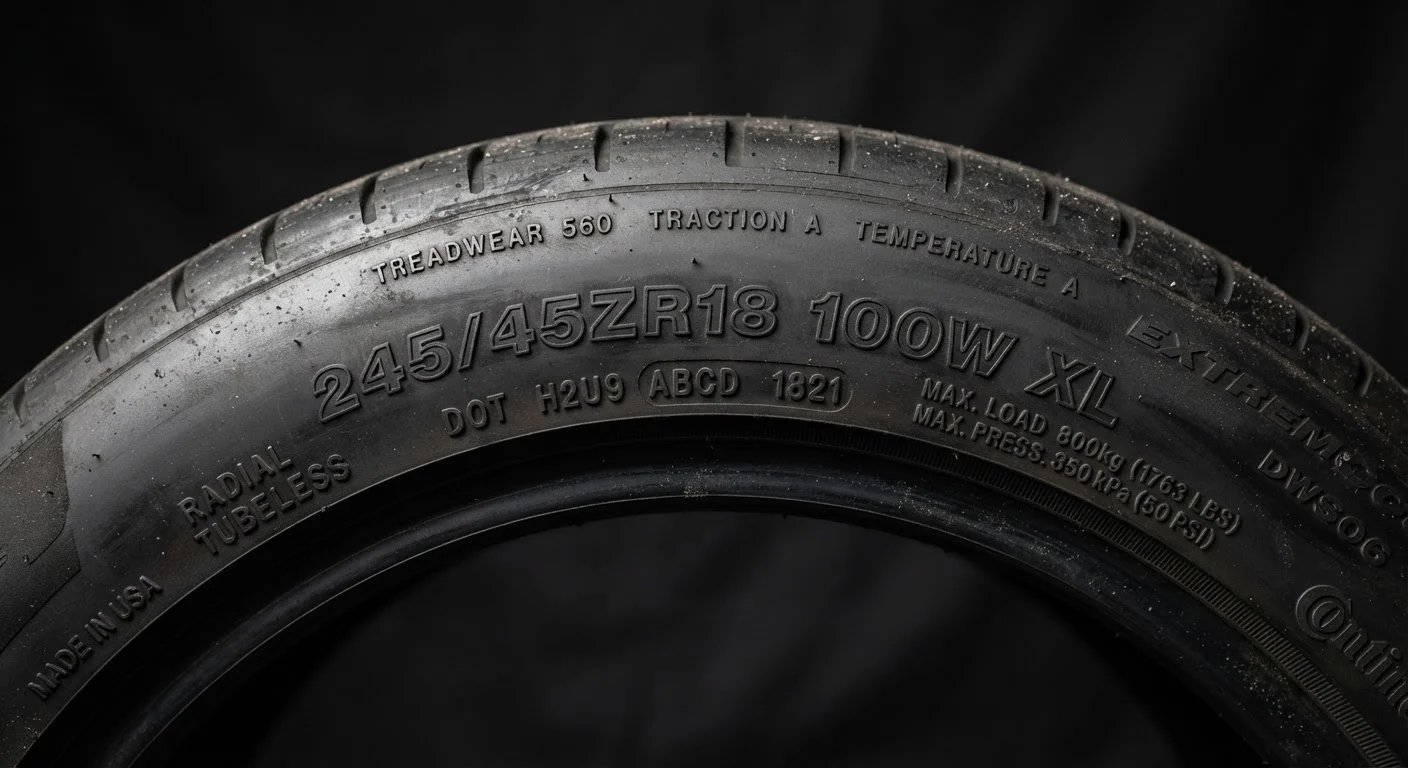
What that string of characters actually means
Look at the sidewall of any passenger car tire and you will find a sequence like P215/65R16 98H. Each character group answers a specific question about the tire's construction and intended use. Reading it correctly lets you confirm that a replacement tire matches your vehicle's requirements, or catch a mismatch before it becomes a safety problem.
| Standard format example | P215/65R16 98H |
| Width unit | Millimeters |
| Rim diameter unit | Inches |
| Most common construction type | Radial (R) |
| Speed rating H equals | 130 mph maximum (Tire and Rim Association standard) |
| Tire age replacement guidance | 6 to 10 years regardless of tread depth (Most vehicle and tire manufacturer guidelines) |
The code follows a structure established by the Tire and Rim Association and mirrored by international standards bodies. Once you know the pattern, every tire on the market becomes readable in under a minute.
Breaking down each segment
Service type prefix
The letters at the very start identify the tire's intended service type. P stands for passenger vehicle. LT means light truck, which typically means a higher load rating and stiffer construction. Some tires carry no prefix at all; those are built to European metric standards and may have slightly different load ratings than a P-metric tire of the same size, so confirm load capacity before substituting one for the other.
Section width
The three-digit number after the prefix is the tire's section width in millimeters, measured from sidewall to sidewall at the tire's widest point when mounted on the specified rim width. A tire marked 215 is 215 mm wide.
Aspect ratio
The two-digit number following the slash is the aspect ratio: the sidewall height expressed as a percentage of the section width. On a 215/65 tire, the sidewall height is 65 percent of 215 mm, which works out to roughly 140 mm. Lower aspect ratios mean shorter sidewalls, which generally means less flex and a firmer ride.
Construction type
The letter after the aspect ratio describes internal construction. R means radial, which is the construction used on virtually all modern passenger and light truck tires. B indicates bias-belt construction, now rare in everyday use. D means diagonal (bias-ply), still found on some trailers and older vehicles.
Rim diameter
The number after the construction letter is the wheel diameter in inches that the tire is designed to fit. A tire marked R16 mounts on a 16-inch wheel. Mixing this dimension with the wrong wheel is not possible during a correct installation; the bead simply will not seat.
Load index
The two- or three-digit number after the rim diameter is the load index. It corresponds to the maximum weight one tire can support at its rated inflation pressure, according to a standardized chart. A load index of 98 corresponds to 1,653 lbs. per tire. Multiplying by four gives the tire set's total load capacity, which must exceed the vehicle's Gross Vehicle Weight Rating (GVWR).
Speed rating
The letter at the end of the sequence is the speed rating, the maximum sustained speed the tire is designed to handle under its rated load. Common ratings include S (112 mph), T (118 mph), H (130 mph), V (149 mph), and W (168 mph). Installing a tire with a lower speed rating than your vehicle's original specification is not recommended, even if you have no intention of approaching those speeds, because the rating also reflects the tire's heat-management design under sustained load.
Aspect ratio
The sidewall height of a tire expressed as a percentage of its section width. A lower aspect ratio means a shorter sidewall and is associated with firmer handling.
Load index
A standardized number that indicates the maximum weight a single tire can support at its rated inflation pressure. The corresponding weight value comes from a published load index chart.
Speed rating
A letter code indicating the maximum sustained speed a tire is designed to handle under its rated load. It also reflects the tire's heat-dissipation characteristics at speed.
UTQG
Uniform Tire Quality Grading, a U.S. government system that grades tires on treadwear, traction, and temperature resistance. The grades are stamped on the sidewall and allow relative comparisons between tires.
DOT serial number
A Department of Transportation identification code molded into every tire sold in the United States. The last four digits encode the week and year of manufacture.
Section width
The measurement in millimeters across the widest part of a mounted tire, from one sidewall to the other, at the correct inflation pressure.
Other markings on the sidewall
Beyond the main size code, tires carry several additional markings worth recognizing.
- DOT serial number: The Department of Transportation identification string ends with a four-digit week-and-year code. A tire ending in 2319 was manufactured in the 23rd week of 2019. Tire age matters because rubber degrades over time regardless of tread depth; most vehicle and tire manufacturers recommend replacing tires older than six to ten years.
- UTQG ratings: The Uniform Tire Quality Grading system stamps three grades on the sidewall: treadwear, traction, and temperature. Treadwear is an index number where higher means longer projected life under standardized test conditions. Traction grades run AA, A, B, C, with AA being highest. Temperature grades run A, B, C.
- Max inflation and load: These figures reflect the tire's absolute maximum, not the recommended operating pressure for your vehicle. Your vehicle's correct inflation pressure is on the sticker inside the driver's door jamb or in the owner's manual, and that number is what you should use.
- Directional or asymmetric indicators: Some tires are designed to rotate in one direction only. Look for an arrow labeled ROTATION or the words OUTSIDE and INSIDE on asymmetric tires. Mounting these incorrectly affects handling and can void the tire's warranty. See how rotation patterns differ for directional tires for more on this.
Knowing how to read the sidewall is one part of broader vehicle upkeep. Your vehicle's maintenance schedule will tell you when tire inspection and rotation intervals fall due so nothing gets overlooked.