
What tire rotation actually does
Each wheel position on a vehicle wears its tire differently. Front tires on a front-wheel-drive car carry braking, steering, and acceleration forces simultaneously, so they wear faster and unevenly compared to the rear pair. Rear tires on a rear-wheel-drive vehicle face their own load bias. Rotation moves each tire to a different position on a set schedule so the wear spreads across all four tires rather than concentrating on two.
The practical result is that all four tires reach the end of their usable tread at roughly the same time, which means you replace the full set together rather than buying tires in mismatched pairs at different intervals. That consistency also keeps handling balanced, because tires with similar tread depths behave more predictably as a set.
Most vehicle manufacturers recommend rotating tires every 5,000 to 7,500 miles, though your owner's manual has the figure specific to your model. See common maintenance intervals for a broader reference on service schedules.
Directional tire
A tire with a tread pattern designed to rotate in one specific direction, usually indicated by an arrow on the sidewall. Mounting it in the wrong direction reduces wet-weather performance and causes abnormal wear.
Non-directional tire
A tire whose tread pattern works correctly regardless of rotational direction, allowing it to be moved to any position on the vehicle.
Staggered fitment
A configuration where the rear tires are a different width (usually wider) than the front tires, common on performance vehicles. This limits or prevents standard front-to-rear rotation.
Asymmetric tire
A tire with different tread patterns on its inner and outer halves, designed to stay in a fixed orientation relative to the vehicle's centerline. The sidewall is marked 'inside' and 'outside.'
Tread depth
The measurement from the top of a tire's tread block to the bottom of the groove. In the U.S., 2/32 of an inch is the legal minimum; 4/32 is when many safety experts recommend replacement.
The main rotation patterns
The pattern used depends on whether your tires are directional or non-directional, whether your vehicle has a matching full-size spare, and the drivetrain layout.
| Typical rotation interval | Every 5,000 to 7,500 miles (General manufacturer guidance; verify in your owner's manual) |
| Pattern for front-wheel drive | Forward cross (fronts go straight back; rears cross forward) |
| Pattern for rear-wheel drive | Rearward cross (rears go straight forward; fronts cross back) |
| Directional tires: rotation options | Same-side front-to-rear only (unless remounted) |
| AWD tread-depth tolerance | All four tires within 2/32 inch of each other (General industry guidance; check your vehicle manufacturer's specification) |
| Full-size spare eligible for rotation | Yes, if it matches the other four tires exactly |
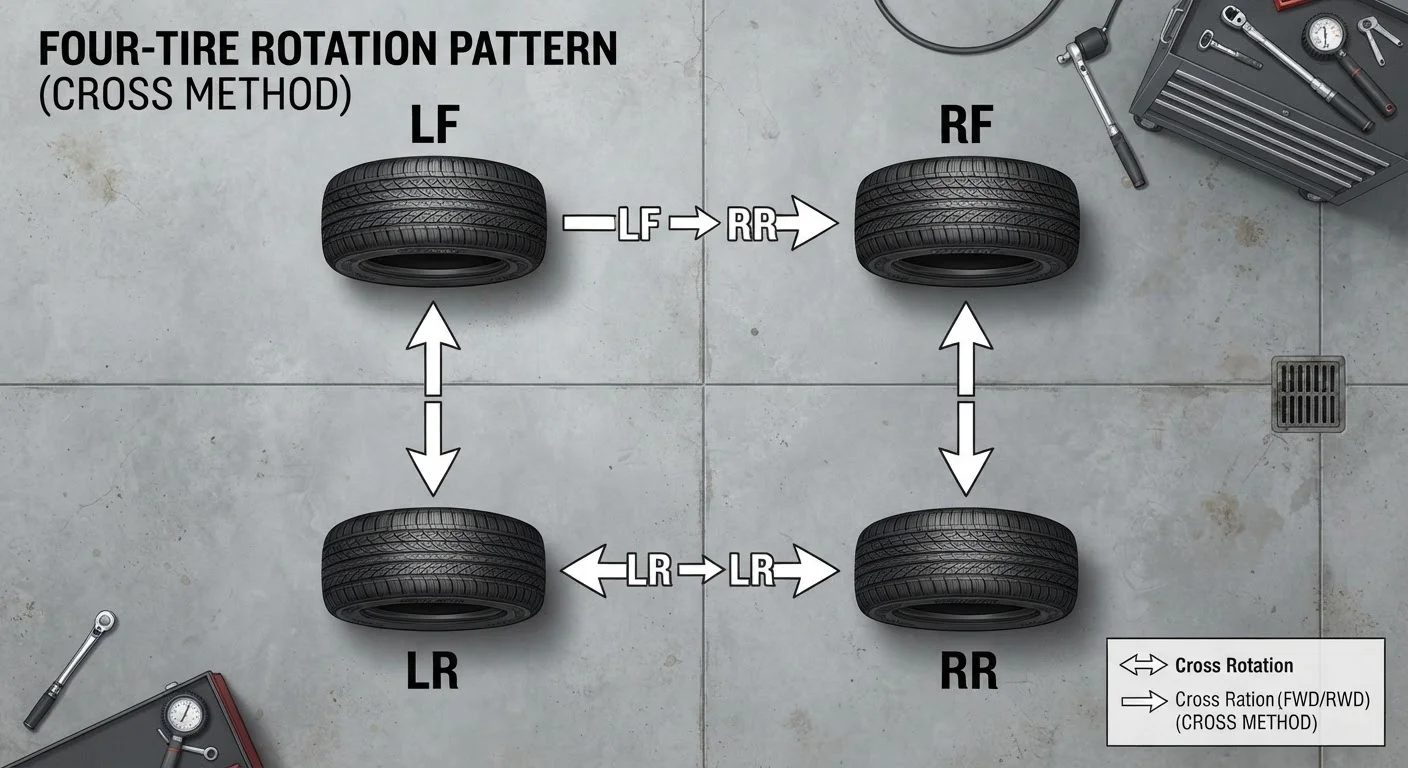
Forward cross
Used on front-wheel-drive vehicles with non-directional tires. The front tires move straight back to the same side. The rear tires cross to opposite sides as they move forward. So the left rear becomes the right front, and the right rear becomes the left front.
Rearward cross
The standard pattern for rear-wheel-drive and four-wheel-drive vehicles. The rear tires move straight forward to the same side. The front tires cross to opposite sides as they move back. This mirrors the forward cross logic but in reverse direction.
X-pattern
All four tires cross to opposite sides as they move, so the left front goes to the right rear, the right front goes to the left rear, and so on. Some technicians use this on front-wheel-drive vehicles when wear has already become noticeably uneven.
Side-to-side
Used exclusively with directional tires, which have a tread pattern that must rotate in one specific direction. Because a directional tire cannot be swapped to the opposite side of the vehicle without dismounting it from the rim, rotation is limited to front-left swapping with rear-left, and front-right swapping with rear-right.
Five-tire rotation
Vehicles with a matching full-size spare can include that spare in the rotation, extending the life of all five tires proportionally. The specific pattern varies by drivetrain. This option is not available with a temporary compact spare.
Directional vs. non-directional tires
Non-directional tires have a symmetrical or asymmetrical tread pattern that works regardless of which way the tire rotates. These can be moved to any position on the vehicle, which gives a technician full flexibility in choosing a pattern.
Directional tires have a V-shaped or arrow-style tread pattern engineered to channel water in one specific direction. Each tire has a marked rotation direction, usually indicated by an arrow on the sidewall. If a directional tire is mounted so it spins the wrong way, its wet-weather performance drops and the tread wears incorrectly. Because of this, directional tires can only swap front-to-rear on the same side of the vehicle unless a tire shop dismounts and remounts them on opposite rims, which adds cost.
Asymmetric tires, a third category, have an outer and inner sidewall that must stay in their designated orientation relative to the vehicle's centerline. Asymmetric tires can move front-to-rear or from side to side, as long as the inner and outer sidewall orientation is preserved. Check the sidewall markings before any rotation.
Uneven wear that persists despite regular rotation often points to an alignment or suspension issue. Signs your alignment is off covers what to look for and why prompt correction matters.
Staggered fitments and limitations
Some performance vehicles use a staggered fitment, meaning the rear tires are wider than the fronts. When this is the case and the tires are also directional, rotation between axles is not possible without remounting, and some manufacturers advise against rotation altogether. If you have a staggered setup, check your owner's manual or consult a tire professional before assuming a standard pattern applies.
All-wheel-drive systems are sensitive to mismatched tread depths across all four tires. Most manufacturers of AWD vehicles specify that all four tires must have very similar tread depth, typically within 2/32 of an inch of each other, to avoid stressing the drivetrain. Regular rotation keeps tread depths consistent. Replacing only two tires on an AWD vehicle without rotating can void drivetrain warranties on some models.
For a full picture of how rotation fits into a broader service plan, understanding your vehicle's maintenance schedule explains how to read the service intervals your manufacturer specifies. Pairing rotation with smooth driving habits reduces uneven wear between rotations as well.