
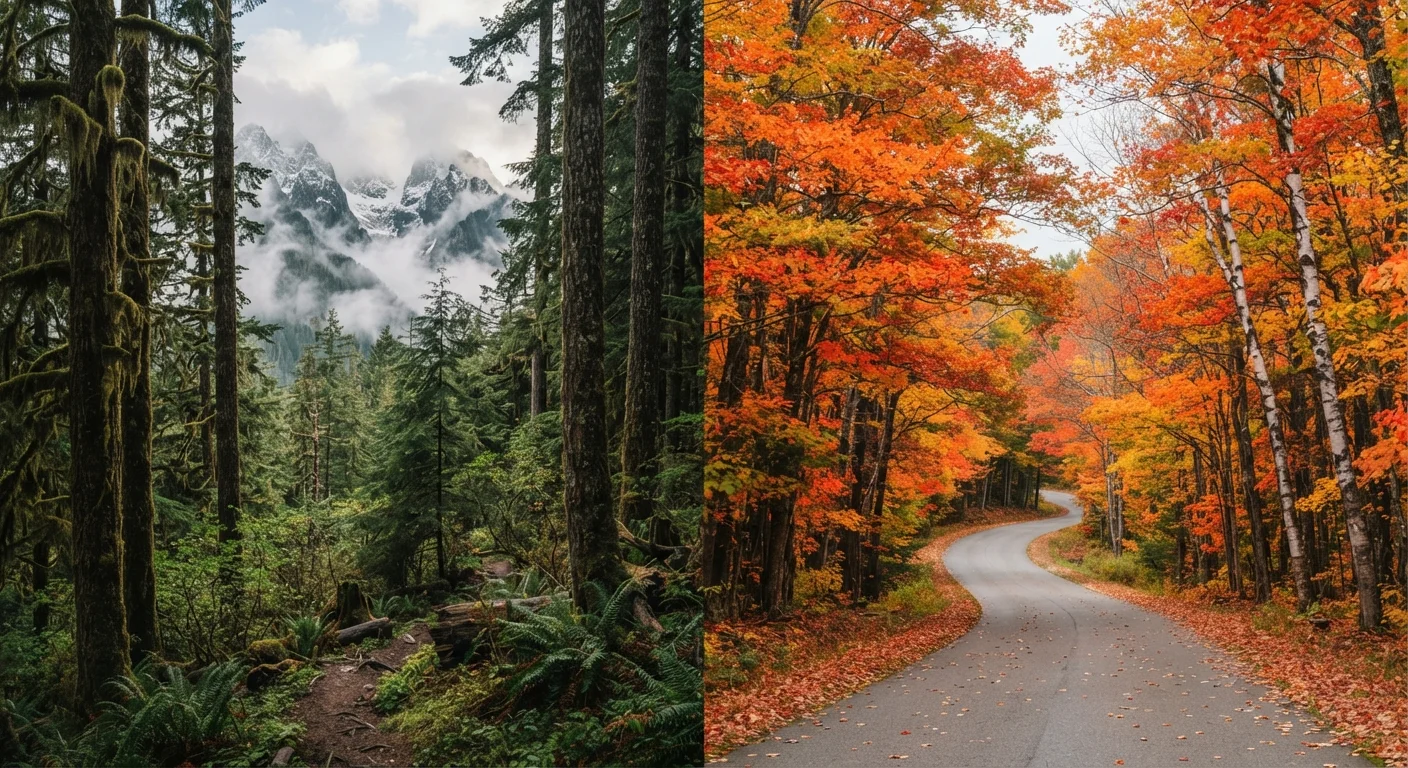
Landscapes and natural character
The Pacific Northwest spans coastal Washington, Oregon, and the northern tip of California, and the sheer scale of its terrain sets it apart. Rainforest valleys in Olympic National Park receive over 140 inches of precipitation annually, producing moss-draped old-growth that feels unlike anywhere else in North America. The Cascade Range runs south from British Columbia through Washington and Oregon, punctuated by composite volcanoes including Mount Rainier, Mount Hood, and Mount St. Helens. The Pacific coastline here is rough and wild: sea stacks, tide pools, and dramatic headlands rather than sandy resort beaches.
New England works differently. Vermont, New Hampshire, Maine, Massachusetts, Connecticut, and Rhode Island together cover less area than a single large Western state. The Appalachian Mountains run through the region, but they are older and more rounded than the Cascades. The real visual drama comes from deciduous hardwood forests that turn scarlet, amber, and gold each autumn, a phenomenon tied to the specific mix of maple, birch, and oak species native to the Northeast. The Maine coast adds granite headlands, lobster harbors, and lighthouse-studded islands to the scenery.
For travelers drawn to nature-based destinations, both regions deliver, just in very different registers. The Pacific Northwest asks you to sit inside scale; New England invites you to move through variety.
| Criterion | Pacific Northwest | New England |
|---|---|---|
| Landscape type | Rainforest, volcanoes, wild coast | Hardwood forest, rounded mountains, granite coast |
| Peak season | July to September | September to October (fall); June to August (summer) |
| Winter travel | Mild coast, accessible year-round | Cold, snowy; many attractions close |
| Driving distances | Long between major sites | Short; six states in compact radius |
| Historical depth | Indigenous heritage; 19th-century settlement | Colonial era through industrial age |
| Signature food | Dungeness crab, Pacific salmon | Lobster, clam chowder, maple syrup |
| Budget camping | Widely available, national forest land | Available; state parks throughout region |
Seasons, weather, and when to go
The Pacific Northwest's reputation for rain is partly earned and partly misunderstood. Seattle and Portland do get frequent overcast days and steady drizzle, particularly from October through April. Summers, however, are often dry, warm, and spectacular, with long daylight hours and reliably clear skies that make July and August the region's peak season. The rain sustains the forests and keeps the region green year-round, so even winter visits have genuine appeal for those who don't mind grey skies.
New England experiences four distinct seasons with real teeth. Winters bring snow, ice, and temperatures that frequently drop well below freezing across interior states. Spring arrives slowly, with mud season a genuine part of local life. Summer is warm and pleasant, particularly along the coast. Fall is when the region draws its largest crowds: foliage typically peaks between late September and late October, moving from north to south across the region. Timing a fall trip to catch peak color involves some planning and a degree of weather luck, since drought or early storms can affect the display.
Travelers with flexibility should weigh their weather tolerance carefully. The Pacific Northwest rewards those who accept overcast skies in exchange for fewer crowds; New England's summer and fall windows are short and competitive for accommodation.
History, culture, and food
New England's cultural depth is inseparable from its age. Boston, Salem, Providence, and Newport carry visible traces of colonial settlement, the Revolutionary War, and the industrial era in their architecture and institutions. The region's universities, including Harvard and Yale, have shaped American intellectual life for centuries. Small-town New England preserves village greens, white-steepled churches, and covered bridges in a way that feels genuinely lived-in rather than staged.
The Pacific Northwest has a shorter post-colonial history, but its Indigenous heritage stretches back thousands of years. Seattle's Pike Place Market, Portland's food-cart culture, and the region's wine and craft beer industry reflect a younger but distinct regional identity. Indigenous cultural sites, particularly along the coast in Washington, offer context that adds meaning to the landscape.
Food is a serious draw in both regions. Pacific Northwest cuisine centers on Dungeness crab, Pacific salmon, Walla Walla onions, and Oregon hazelnuts. New England's table runs on lobster, clam chowder, maple syrup, and apple orchards. Neither tradition is one you can replicate reliably outside the region, which makes eating local a real part of the trip in both cases.
For a broader look at American wilderness by region, America's national parks region by region covers the full range of landscapes worth considering.
Practical considerations for U.S. travelers
Getting around the Pacific Northwest almost always requires a rental car outside of Seattle and Portland city limits. Distances between parks and coastal towns are long, and public transit options in rural areas are limited. Budget travelers can find affordable camping throughout the region, with national forest land offering low-cost or free dispersed camping options alongside the more popular national park sites.
New England is more compact and, in parts, more transit-accessible. Amtrak's Downeaster connects Boston to Portland, Maine. Regional rail and bus services link many larger towns. However, seeing rural Vermont or the Maine coast still generally requires a car. The region's density means accommodation can fill quickly during peak foliage weeks, and prices in coastal towns like Kennebunkport or Nantucket can run high during summer.
Both regions have entry points suited to different budgets. Camping, state parks, and free public lands exist alongside premium lodges and boutique inns in each area. The city break versus slow travel tradeoff that applies to European trips translates here too: a longer, slower trip through one region often reveals more than a rushed sweep through both.
140+
Annual inches of rain in parts of Olympic National Park
The Hoh Rain Forest in Olympic National Park, Washington, is one of the wettest temperate rainforests in the United States, according to National Park Service data.
~3 weeks
Typical window for peak fall foliage in New England
The U.S. Forest Service notes that peak leaf color in New England generally moves from north to south over roughly three weeks between late September and late October.
6 states
States covered in a New England road trip
All six New England states together cover approximately 71,000 square miles, making the region one of the most compact multi-state travel circuits in the country.