What depreciation actually means for your wallet
Depreciation is often described as the single largest cost of car ownership, yet it never appears as a line item on your monthly statement. Unlike a loan payment or an insurance premium, it is a silent reduction in asset value that accumulates every month you own the vehicle.
A car that costs $35,000 new might be worth $26,000 after one year and $20,000 after three years, depending on the model and market conditions. That $15,000 gap is real economic loss. It does not go to a lender or an insurer; it simply disappears from your balance sheet.
For most American drivers, a vehicle is the second-largest asset they own after a home. Treating depreciation as an afterthought means making loan, insurance, and resale decisions without a full picture of the costs involved. The total cost of car ownership only makes sense when depreciation is included.
Factor depreciation before you sign
Before financing a vehicle, look up its projected resale value at the two and three year marks using a third-party valuation tool. Compare that figure to what your loan balance will be at the same point. If the loan balance exceeds the projected value, consider a larger down payment or a shorter loan term to reduce your negative equity risk.
How depreciation affects your loan balance
The relationship between depreciation and your loan balance is where things get financially consequential. When you finance a vehicle, your early payments are weighted toward interest, so your loan balance drops slowly. Meanwhile, the car loses value quickly. This combination can leave you in a position where you owe more than the vehicle is worth, a condition lenders call negative equity or being underwater.
Being underwater is not just an abstract concern. If you want to sell or trade in the vehicle before the loan is paid off, you either need to make up the difference out of pocket or roll that balance into a new loan, which extends your debt and repeats the cycle.
Buyers who put less money down upfront are more exposed to this risk. A larger down payment offsets the initial depreciation drop, reducing the gap between loan balance and market value in the critical first years. Gap insurance, which covers the difference between your loan payoff and your insurer's actual cash value payout, exists specifically because this scenario is common. See guidance on managing debt if negative equity is affecting your broader financial position.
15-25%
Value lost in year one for most new cars
Industry estimates from vehicle valuation sources consistently show new cars lose a significant share of their purchase price in the first twelve months.
~50%
Typical value remaining after five years
Many new vehicles retain roughly half their original value by the five-year mark, though this varies considerably by make, model, and market conditions.
$0
Direct cash cost of depreciation each month
Depreciation does not appear on a monthly bill, making it easy to overlook despite being one of the largest cumulative costs of vehicle ownership.
Depreciation and insurance payouts
Standard auto insurance policies pay actual cash value (ACV) when a vehicle is declared a total loss. ACV is the market value of the car at the moment of the loss, which accounts for depreciation. A vehicle that cost $32,000 two years ago might carry an ACV of $22,000. If you still owe $26,000 on the loan, the insurer pays $22,000 and you cover the remaining $4,000 yourself unless you have gap coverage.
This is not a quirk or loophole in insurance contracts; it reflects how asset valuation works. The insurer is not required to pay off your loan, only to compensate you for the value of what was lost. Understanding this distinction before you need to file a claim gives you time to evaluate whether gap insurance or a similar product makes sense for your situation. Reviewing your coverage regularly, as discussed in vehicle ownership cost control practices, helps you stay aligned with your car's actual value.
Timing your sale around the depreciation curve
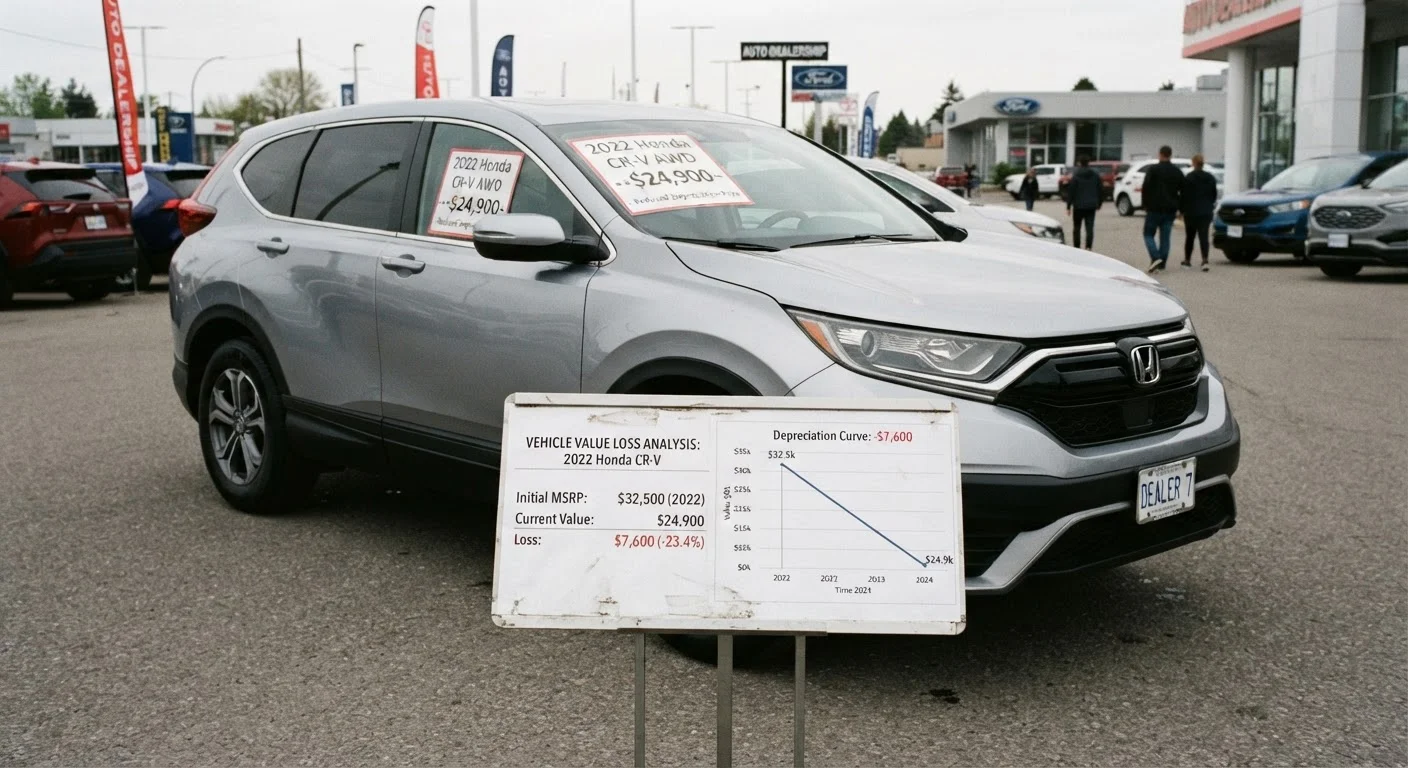
Depreciation is not linear. A new car depreciates fastest in its first year, then slows through years two and three, and levels off somewhat after that. This curve has practical implications for when you decide to sell.
Selling in year one means absorbing the largest single-year loss. Holding the car through the steepest depreciation years and then selling before it crosses high-mileage thresholds often preserves more value. Most buyers and dealers pay attention to mileage milestones, typically around 60,000 and 100,000 miles, so timing a sale before those points can influence what you receive.
Condition matters as well. A well-maintained vehicle with documented service history will command a higher price than an equivalent model without records. Consistent car maintenance is not just about reliability; it directly affects resale value.
For drivers weighing whether to keep financing, trade in, or consider leasing, the depreciation curve is one of the clearest inputs for that decision. Leasing versus owning each carry different depreciation exposure, and understanding which side of the curve you are on at any given moment shapes which option costs less over time.
Depreciation varies significantly by vehicle type
Pickup trucks and certain SUVs have historically held their value better than many sedans and luxury vehicles. Electric vehicles introduce additional uncertainty because battery technology and charging infrastructure are still evolving, which makes long-term resale projections less predictable. Check current market data for any specific model you are considering rather than relying on general averages.