
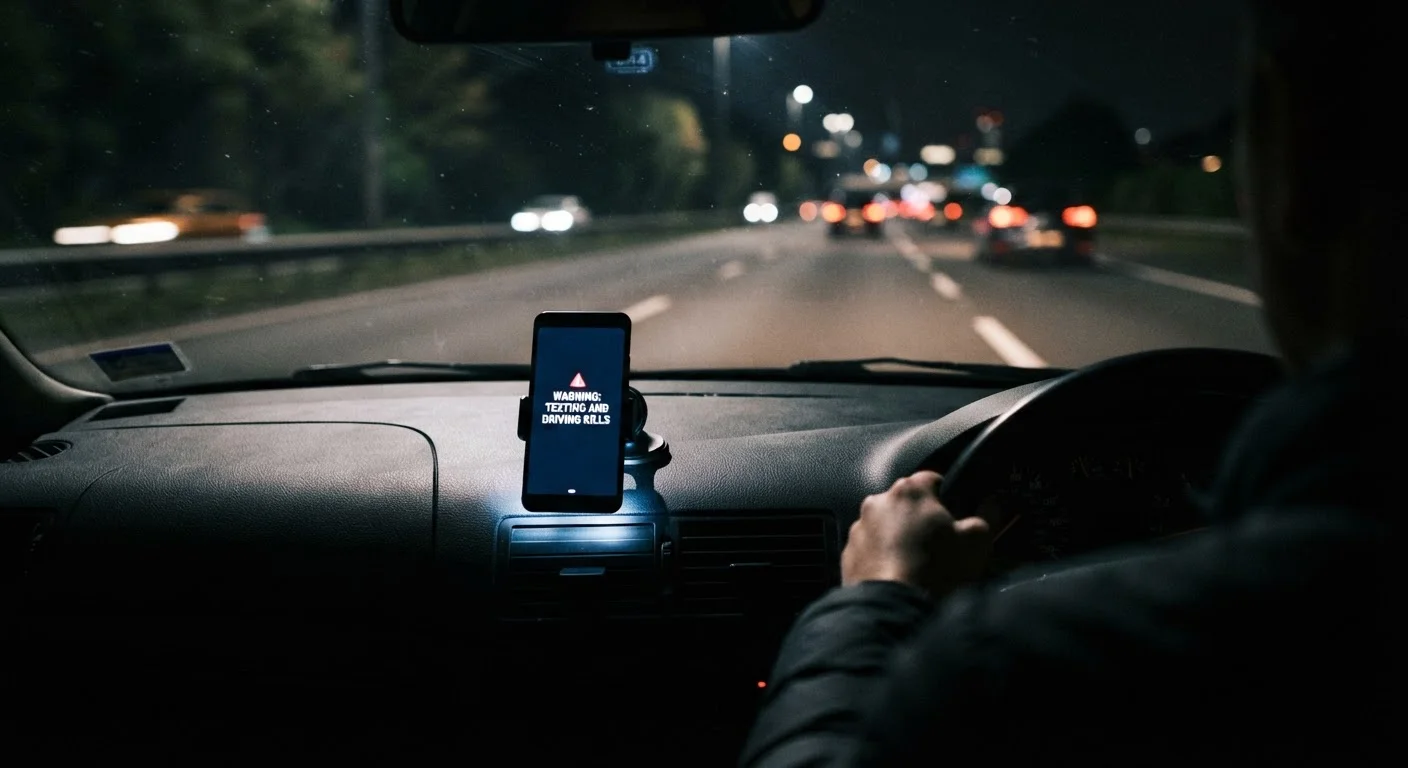
Why phone distraction is worse than it feels
Most drivers who use their phones behind the wheel do not believe they are taking a serious risk. The phone use feels controlled, the road feels manageable, and nothing bad happens most of the time. This gap between perceived and actual risk is one of the core problems. Distraction is invisible in the moment: the driver does not feel slower, does not notice narrowed attention, and receives no feedback until something goes wrong.
Distracted driving researchers describe three categories of distraction: visual (eyes off the road), manual (hands off the wheel), and cognitive (mind off the task of driving). Texting combines all three. Hands-free calling eliminates the first two but leaves the most consequential one, cognitive distraction, fully intact.
The same attentional limits that make phone use dangerous apply to other focus problems behind the wheel. Driving fatigue warning signs follow a similar pattern: the driver feels capable while performance actually degrades.
Myth
As long as I glance at my phone for just a second, I am not really distracted.
Fact
Even a brief glance lasts far longer than drivers perceive, and the road travels a significant distance during that time.
At 55 mph, a vehicle travels approximately 80 feet per second. A glance that feels like one second commonly lasts three to five seconds in practice. That means a driver looking down for what feels like a moment may cover the length of a football field without watching the road. The National Highway Traffic Safety Administration (NHTSA) uses exactly this calculation to illustrate why no glance at a phone is truly brief.
Myth
Hands-free phone calls are safe because my eyes stay on the road.
Fact
Keeping your eyes forward does not prevent cognitive distraction; your brain still diverts attention from the driving task.
Vision and attention are not the same thing. When a driver is engaged in a phone conversation, the brain allocates processing resources to language comprehension and formulating responses. This leaves fewer resources for detecting pedestrians, reading traffic signals, or reacting to a merging vehicle. The National Safety Council classifies hands-free phone use as a cognitively distracted activity that can reduce driver awareness of road events by a measurable margin.
A passenger conversation does not cause the same degree of impairment, partly because passengers naturally pause when road conditions change. A caller on the other end of a phone has no awareness of what is happening on the road and does not adjust. For more on how conversations affect focus, see how passenger conversations affect driver focus.
Myth
Voice-to-text is a safe way to send messages while driving.
Fact
Composing any message, by voice or by typing, imposes significant cognitive load that impairs driving performance.
Voice-to-text removes the need to look at the screen, but it does not remove the mental effort of forming a message, listening to playback, and correcting errors. Studies conducted by the Texas A&M Transportation Institute found that drivers using voice-to-text took longer to respond to events and spent more time with eyes off the road compared to driving without any phone interaction. The task feels easier than typing, but the cognitive cost remains high.
Myth
Experienced drivers can handle a quick phone check because they know the road well.
Fact
Driving experience does not offset the physiological effects of divided attention.
Experience improves hazard recognition and vehicle control under normal conditions, but it does not change how the human brain allocates attention. When cognitive load increases sharply, reaction time slows for all drivers regardless of years behind the wheel. NHTSA data consistently show that distracted driving crashes occur across all age groups, and experience does not provide meaningful protection once attention is divided. Teen drivers carry additional risk for separate reasons, which research on teen driver crash risk addresses in detail.
Myth
If traffic is moving slowly or I am at a red light, phone use is not a real danger.
Fact
Slow-moving or stopped traffic can change rapidly, and cognitive distraction persists for several seconds after putting the phone down.
A stopped vehicle can still roll forward, and intersections are among the highest-risk locations for crashes regardless of speed. Beyond that, research shows that cognitive distraction lingers after a driver sets the phone down: the brain takes roughly 27 seconds to fully return to the level of attention needed for safe driving. Using a phone at a red light means the distraction may still be affecting performance well after the light turns green.
What the evidence consistently shows
The research record on phone use and driving is consistent across institutions and methodologies. Reaction time slows. Lane-keeping accuracy drops. Following distances shorten. These are measurable, reproducible outcomes, not theoretical risks.
23x
Increased crash risk while texting
NHTSA and the Virginia Tech Transportation Institute have cited this figure in research on texting and driving crash risk.
~27 sec
Time for full attention to return after phone use
Research from the AAA Foundation for Traffic Safety found cognitive distraction persists for up to 27 seconds after completing a phone task.
50%
Visual information missed during phone calls
The National Safety Council estimates drivers on phone calls can miss up to half of what they visually scan while driving.
One practical way to understand the scale of the problem: at highway speed, the distance a car covers during a five-second phone glance is roughly equivalent to the length of an average football field. That stretch of road passes with no driver attention on it at all.
Defensive driving techniques are built around maintaining awareness of the full environment around the vehicle. Phone use collapses that awareness directly. For a fuller picture of what attentive driving actually requires, defensive driving fundamentals covers the scanning habits and space management involved.
Distraction does not pause when danger appears
A driver looking at a phone cannot fully process a sudden hazard, even if the car is moving slowly. The brain does not split attention equally between a phone conversation and driving. Research from the National Safety Council indicates that up to 50 percent of what a driver should see goes unregistered when the brain is occupied with a phone task.
Low visibility compounds these risks. A driver who is already cognitively distracted and encounters a low-light environment has even less margin to respond. Nighttime driving risks are a separate category, but they interact with distraction in ways that raise overall crash likelihood substantially.
Hands-free does not mean risk-free
Many drivers assume a Bluetooth call or speakerphone eliminates distraction. It does not. The cognitive load of holding a conversation diverts mental resources away from scanning the road, tracking other vehicles, and responding to changes in traffic. Mounting research shows hands-free phone use still produces measurable impairment in braking response and lane-keeping accuracy.
The safest approach is to treat any phone interaction as incompatible with driving, regardless of speed, road familiarity, or perceived skill level. Silencing notifications before starting the engine removes the temptation before it becomes a decision under pressure.