
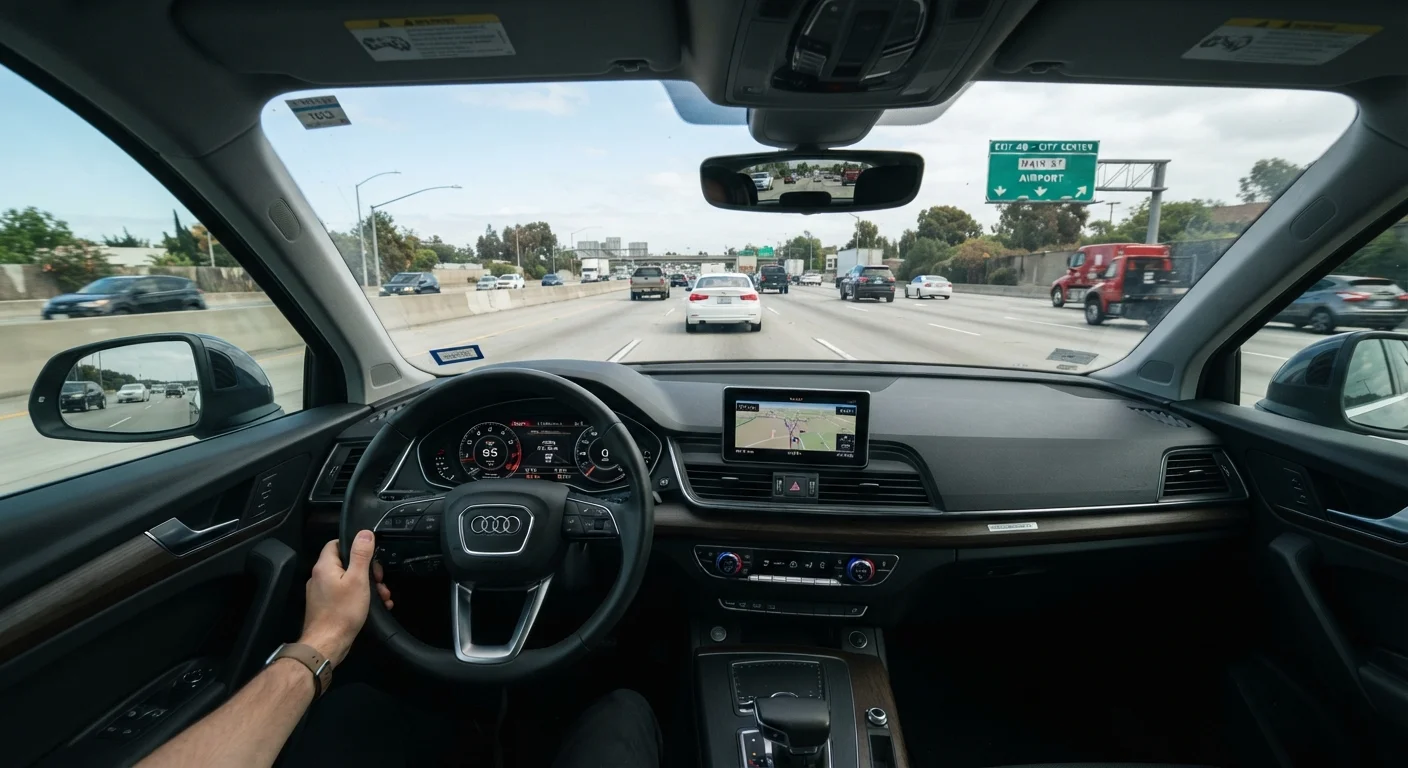
What defensive driving actually means
Defensive driving is a set of habits built on the assumption that other drivers will make mistakes. Rather than trusting that every other vehicle will behave predictably, a defensive driver prepares for the unexpected and positions their vehicle to have options when something goes wrong.
The term is sometimes reduced to "keep your eyes on the road," but that framing misses most of what the practice involves. Defensive driving covers how you scan the environment, how much space you leave around your car, how you read other drivers' behavior, how you respond to changing conditions, and how you manage your own attention. Each of those areas has specific, learnable habits behind it.
Formal defensive driving courses, such as those offered through programs recognized by the National Safety Council, teach a structured framework. The core idea is that a driver who anticipates hazards has far more time to avoid them than one who only reacts after a problem appears.
The scanning habit that separates safe drivers
Most drivers focus on the car directly in front of them. Defensive drivers scan much farther ahead, typically 12 to 15 seconds down the road at highway speeds, while cycling attention back through mirrors every five to eight seconds.
This rotation matters because hazards rarely announce themselves at close range. A driver who sees brake lights appearing three cars ahead has several seconds to ease off the throttle before the car in front actually slows. A driver watching only the nearest bumper has almost no time.
Mirror checks are not optional. The location and management of blind spots affects how much you actually see in mirrors alone. Combining mirror checks with periodic head checks for lane changes fills in what mirrors cannot show.
When entering a new traffic environment, such as a freeway merge or a busy intersection, briefly narrate the scene to yourself: where the nearest vehicles are, which direction hazards could come from. This habit forces active attention rather than passive monitoring.
Active verbalization of a scene is a technique used in professional driver training to prevent the scanning process from becoming mechanical and unprocessed.
If you realize you have been watching the same car for an extended time without cycling through your mirrors, treat that as a signal to reset your scan pattern immediately.
Fixation on a single object is one of the most common attentional errors in driving. Recognizing and interrupting it is a trainable habit.
The scan cycle looks like this: far-ahead road, mid-range traffic, left mirror, center mirror, right mirror, then back to far ahead. On city streets, the far-ahead distance shortens, but the mirror cycle frequency increases because cross-traffic and pedestrians appear from more directions.
Managing space around your vehicle
Space is the resource a defensive driver manages most deliberately. A gap between your vehicle and the one ahead gives you stopping distance. Space on your sides gives you somewhere to go if a lane-change goes wrong. Space behind matters less in your control, but awareness of a tailgater affects decisions about braking and speed.
The standard recommendation for following distance in normal conditions is a minimum of three seconds between your front bumper and the vehicle ahead. Measure it by picking a fixed point on the road, watching when the car ahead passes it, and counting until you reach the same point. Following distance needs shift between rural and urban environments because the types of hazards and stopping speeds differ considerably.
On a multi-lane road, avoid driving in another vehicle's blind spot. Position yourself so you are either clearly ahead of or clearly behind adjacent vehicles. Traveling at the same speed as a vehicle beside you for any extended period reduces your options if either car needs to change lanes suddenly. See our highway driving overview for more detail on lane positioning at speed.
Speed and the two-second rule
Speed is the most direct factor in crash severity. Higher speeds increase stopping distance exponentially, not linearly, so the difference between 60 mph and 75 mph is not just 15 mph of extra momentum. It is a substantially longer stopping distance and a much narrower window to avoid a collision.
The posted speed limit assumes ideal conditions: dry pavement, good visibility, functioning vehicle equipment. When conditions degrade, that limit is no longer an appropriate ceiling. Rain, snow, fog, construction zones, and heavy traffic all call for speed reductions even when other drivers maintain the limit.
A useful reference point is that stopping distance at 60 mph on dry pavement is roughly 180 feet for an average passenger vehicle, not counting the distance traveled during reaction time. On wet pavement, that figure increases. Any speed reduction proportionally reduces both the stopping distance and the severity of impact if a collision does occur.
Recognizing driver behavior around you
Part of defensive driving is reading other vehicles as sources of information about likely behavior. A car drifting within its lane, sudden brief braking, inconsistent speed, or an extended turn signal without a lane change can all signal a driver who is distracted, fatigued, or impaired.
When you identify a vehicle behaving unpredictably, the appropriate response is to increase your distance from that vehicle and, if possible, change lanes to remove yourself from their immediate vicinity. Staying directly behind or beside an erratic driver keeps you in the zone where their mistakes are most likely to affect you.
Aggressive driver behavior is a different category. Tailgating, rapid weaving, and aggressive gesturing from another driver are signals to create distance, not to match their behavior or engage. Responding to aggression with aggression removes your defensive posture entirely.
Distractions, fatigue, and mental load
A driver cannot apply any of the above habits while mentally elsewhere. Phone use while driving consistently appears in research as a severe impairment to reaction time, comparable in effect to blood alcohol levels above the legal limit. Hands-free operation reduces physical distraction but does not eliminate the cognitive load of a conversation.
Passenger conversations and in-car activity also carry cognitive cost. A complex conversation while driving occupies the same mental resources needed for hazard detection. Reducing conversation complexity in demanding traffic conditions is a concrete, practical adjustment.
Fatigue deserves the same weight as alcohol impairment. A driver who has been awake for 18 hours shows cognitive and reaction-time deficits consistent with a blood alcohol concentration of 0.05%, according to research cited by the National Highway Traffic Safety Administration. Recognizing fatigue before it becomes dangerous, and stopping to rest, is a direct defensive driving decision.
Smooth, consistent driving habits also help: gradual acceleration and early, gentle braking give you more time to scan, and they reduce the physical wear that can contribute to mechanical failures at the worst moments.
Conditions that require a different approach
Weather, road type, time of day, and traffic density all change what defensive driving looks like in practice. Rain reduces tire grip and visibility simultaneously, making longer following distances and lower speeds necessary at the same time. Glare from low sun angles at dawn and dusk reduces how far ahead a driver can see effectively.
Night driving reduces peripheral vision and makes pedestrian detection harder. High-beam headlights improve visibility when no oncoming traffic is present, and dimming them promptly avoids blinding other drivers. Reduced speed at night is a direct compensating measure for reduced stopping reaction time due to shorter visible range.
Construction zones compress lanes, introduce unexpected lane shifts, and bring workers close to moving traffic. Speed reductions in these zones are legal requirements in most states and also reflect genuine changes in stopping distance relative to available space. Following the posted construction zone speed and maintaining extra following distance accounts for both the narrower lanes and the possibility of sudden stops ahead.