
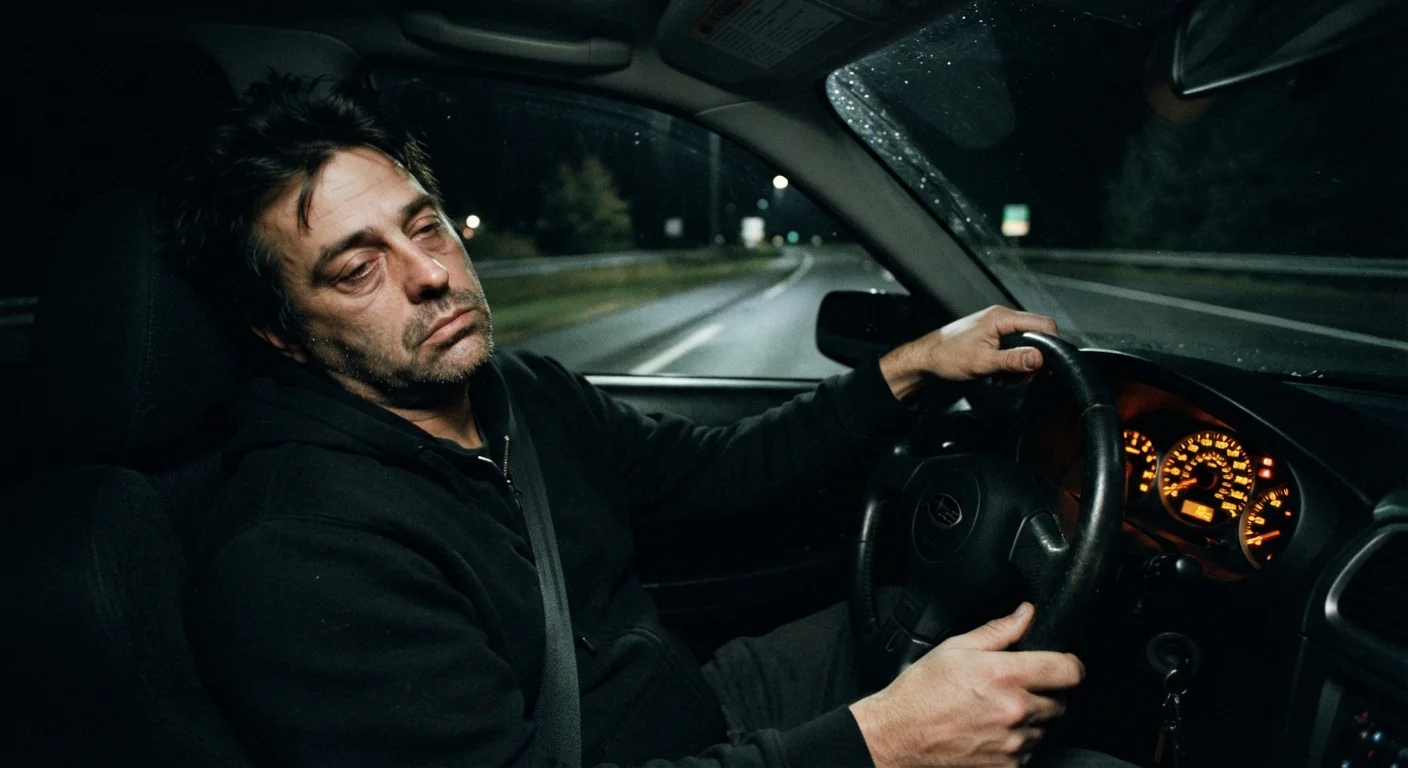
Why drivers underestimate fatigue behind the wheel
Fatigue is one of the most misread states in driving. Unlike alcohol impairment, which a driver often knows about before getting in the car, sleep deprivation builds gradually and clouds the very judgment needed to assess it. A tired brain is poor at estimating how tired it is, which is a direct contributor to the decisions that lead to drowsy-driving crashes.
The problem compounds because many warning signs feel ordinary. Yawning, heavy eyes, and drifting attention are things drivers experience on alert days too, so they absorb these cues as routine rather than reading them as a stop signal. Nighttime driving raises the stakes further, because circadian pressure is highest between midnight and 6 a.m. and again in the early afternoon, when crash rates tied to fatigue spike even among otherwise rested drivers.
100,000
Police-reported drowsy driving crashes annually
The National Highway Traffic Safety Administration (NHTSA) estimates approximately 100,000 police-reported crashes each year involve drowsy driving as a factor.
2x
Crash risk with 6-7 hours of sleep
The AAA Foundation for Traffic Safety found that drivers sleeping six to seven hours per night doubled their crash risk compared to those sleeping eight or more hours.
37%
U.S. adults reporting unintended sleep in the past month
The Centers for Disease Control and Prevention (CDC) has reported that more than one-third of U.S. adults say they have fallen asleep unintentionally at least once in the past 30 days.
Common warning signs drivers dismiss
The signs below are not rare or subtle: they appear on most drowsy-driving trips before a serious incident occurs. The issue is that drivers interpret them as manageable rather than as reasons to stop.
Dismissing lane drift as a distraction problem rather than a fatigue sign.
Why it happens: Drifting out of your lane feels like a moment of inattention, and drivers often blame a phone, a passing thought, or road noise. The distinction matters because fatigue causes involuntary micro-corrections that repeat, while ordinary distraction usually does not.
Convincing yourself that powering through a short remaining distance is safe.
Why it happens: When a destination is close, the mental calculus shifts toward finishing rather than stopping. Drivers underestimate how significantly their judgment degrades in the final miles of a fatigued trip.
Ignoring heavy eyelids and frequent blinking as normal tiredness that will pass.
Why it happens: Eyes naturally feel heavier after long drives, and drivers normalize the sensation rather than reading it as a warning. Frequent blinking and burning eyes indicate the brain is already struggling to stay in an alert state.
Missing exits or forgetting the last few miles driven.
Why it happens: Drowsy drivers experience gaps in conscious awareness called microsleeps, which last two to three seconds on average. Because the driver regains awareness without realizing attention was lost, they attribute missed exits to being preoccupied rather than asleep.
Relying on a co-passenger conversation to stay alert.
Why it happens: Talking to someone in the car feels like active mental engagement, and many drivers believe conversation will offset fatigue. It reduces the sensation of sleepiness but does not reverse the underlying neurological state.
Phone use and distraction are often blamed for crashes that fatigue actually caused. The behaviors overlap enough that a tired driver who drifts and corrects may assume a glance at the phone was responsible, which leads to the wrong response.
What actually works when you are too fatigued to drive
Most interventions drivers reach for do not address the underlying problem. Cold air, loud music, face-washing, and conversation are comfort measures, not corrective ones.
Do not rely on caffeine to keep driving
Caffeine can reduce the sensation of sleepiness for 30 to 45 minutes, but it does not restore the cognitive processing and reaction time lost to sleep deprivation. Drivers who use coffee or energy drinks to push through fatigue often experience a sharp drop in alertness once the stimulant effect fades, sometimes while still on the road.
The two responses with documented effectiveness are a short nap of 20 minutes or less, ideally combined with a caffeine drink consumed just before sleeping (so it takes effect during recovery), and handing the wheel to a rested driver. Both require stopping. Planning rest stops before fatigue appears rather than after it is already present is the more reliable approach for long trips. Consistent safe driving habits, including trip planning, reduce both crash risk and mechanical strain over time.
Fatigue impairs driving like alcohol
Research from the AAA Foundation for Traffic Safety found that drivers who sleep only six to seven hours in a 24-hour period are twice as likely to crash as those who sleep eight hours. Going without sleep for 20 hours produces impairment comparable to a blood alcohol concentration of 0.08%. If you are dismissing fatigue warning signs, you may already be at that level of impairment.
If you are regularly fatigued during normal-length drives rather than only on long trips, that pattern warrants attention beyond road safety. The CDC notes that insufficient sleep is common across the U.S. adult population, and conditions like sleep apnea can cause serious fatigue without the driver being aware of their diagnosis.