Why passengers occupy more mental space than drivers expect
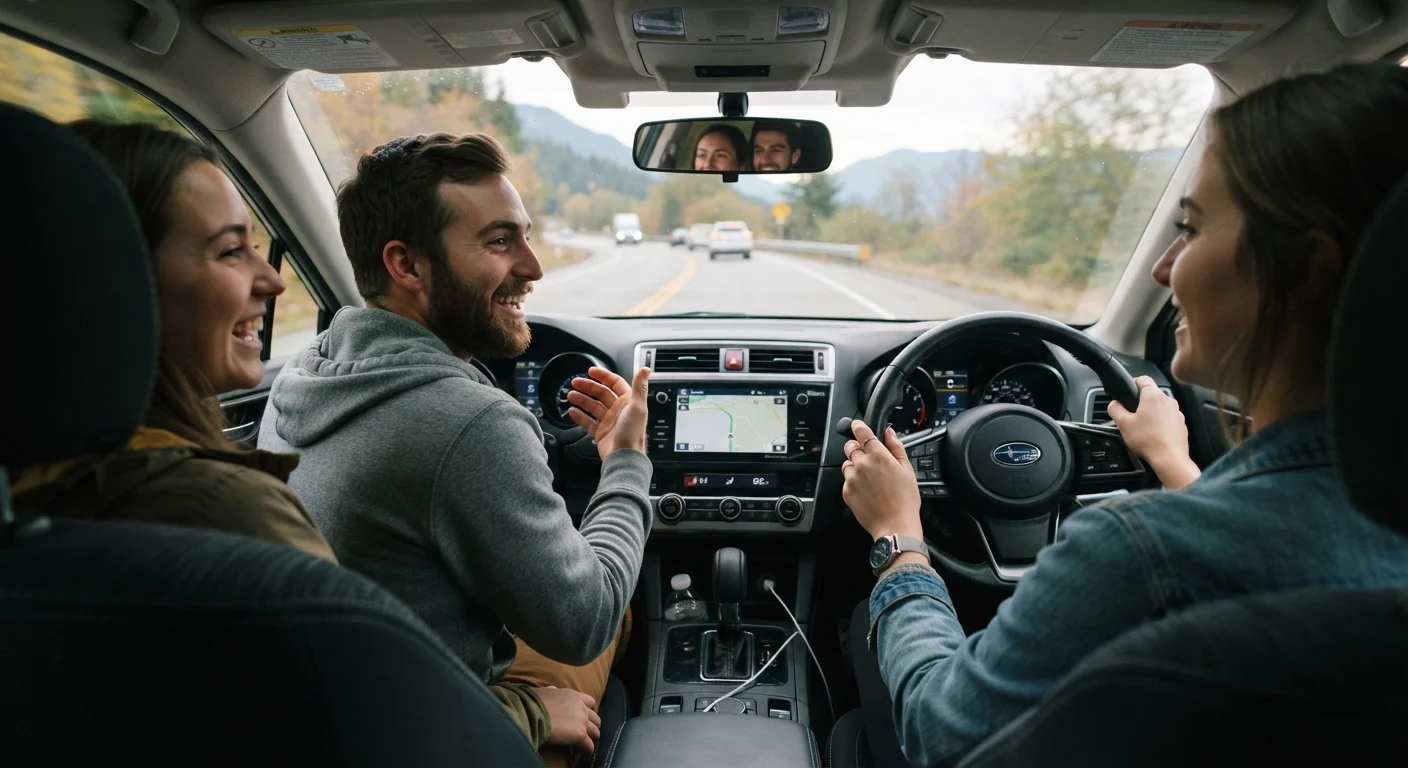
Most drivers instinctively know that staring at a phone is dangerous. Far fewer recognize that the person in the passenger seat can pull their attention off the road just as effectively. The mechanism is cognitive load: the brain has a finite capacity for processing information, and conversation draws from the same mental resources needed to track traffic, read signs, and anticipate hazards.
A conversation is not passive for the brain. It requires listening, formulating responses, maintaining social context, and regulating tone, all simultaneously. When driving conditions are simple, a typical driver has enough spare capacity to manage this. When conditions grow complex (merging traffic, an intersection, adverse weather) that spare capacity disappears fast, and the conversation wins out over hazard detection in ways the driver rarely notices in the moment.
This is distinct from phone use behind the wheel, where the driver is literally absent from the shared environment. A passenger can see the same road and adjust the conversation accordingly. That said, a passenger who cannot or does not read driving cues provides little of that protective benefit.
Cognitive distraction is invisible to other drivers
A driver having an intense conversation looks the same from outside the vehicle as an attentive driver: hands on the wheel, eyes forward. This makes cognitive distraction harder to police or observe than phone use. It also means drivers must self-regulate, since no external cue signals to them that their processing capacity is being consumed.
The specific risk for teen and young adult drivers
The interaction between inexperience and passenger presence is documented clearly in crash data. Teen drivers already face disproportionately high crash rates, and carrying peer passengers amplifies that risk further. The National Highway Traffic Safety Administration (NHTSA) and research through organizations such as the AAA Foundation for Traffic Safety have consistently found that teen crash risk increases with each additional peer in the vehicle.
Two factors drive this. First, new drivers have not yet automated the core mechanics of vehicle control, so steering, braking, and scanning still demand conscious attention. Adding social noise shrinks an already thin margin. Second, peer passengers affect decision-making: speed choices, gap acceptance at intersections, and reactions to peer encouragement all shift in riskier directions when friends are watching.
Adult passengers in a teen's vehicle tend to have the opposite effect, partly because they are more likely to express concern and partly because the social dynamic does not reward bravado.
Emotionally charged conversations and their outsized effect
Not all in-car conversations carry equal weight. A routine exchange about directions or what to have for dinner draws relatively little cognitive load. An argument, a distressing piece of news, or an emotionally significant discussion is a different matter entirely.
Emotional arousal narrows attention. When a driver is upset, worried, or in conflict with a passenger, the brain prioritizes the emotional content over peripheral information. Reaction times increase, hazard detection degrades, and the driver may not register events at the edge of the visual field. This is the same attentional narrowing that makes blind spot checking more likely to be skipped during high-stress driving.
Practical implication: if a conversation in the vehicle becomes heated or distressing, postponing it is not avoidance. It is a reasonable safety measure. Reducing speed in complex traffic sections and asking for a pause in the discussion are both appropriate responses.
Use traffic complexity as a natural pause signal
Train yourself to treat heavy traffic, construction zones, and unfamiliar intersections as natural cues to let conversations drop off. Most passengers will understand a brief pause when the driving situation clearly demands it. Resuming the conversation once conditions ease is easier than recovering from a collision.
Other cabin activity that affects focus
Conversation is the most studied form of passenger distraction, but the cabin produces other attention demands worth naming. Children in rear seats generate distraction events that are often visual and manual, as drivers turn around or reach back to assist. Research published by Monash University Accident Research Centre estimated that child passengers produced distraction far more frequently per trip than adult passengers, though the exact figures vary by study design.
Music and audio content add another layer. Adjusting volume or changing tracks takes hands off the wheel and eyes off the road briefly. At highway speeds, even a two-second glance away covers a substantial distance. Passengers who control in-car entertainment on behalf of the driver help with the manual component, but the audio itself still adds to overall cognitive load when it demands active listening.
Navigation instructions from a passenger can help or hinder depending on timing and clarity. A passenger who gives a direction calmly and early gives the driver time to respond. One who calls out a turn at the last second forces a rushed decision under pressure.
Defensive driving habits include managing the cabin environment as part of overall hazard reduction, not just watching the external road.
Practical habits for managing passenger distraction
Awareness of the problem is the first step; adjusting behavior in the moment is what reduces risk. A few habits make a measurable difference.
- Set cabin expectations before complex driving begins. On a long highway trip or in unfamiliar city traffic, asking passengers to hold involved conversations for a rest stop is a reasonable request.
- Lower audio volume when entering demanding traffic situations. This is a quick action that frees up processing capacity without requiring anyone else to change behavior.
- Do not resolve emotional conflicts while driving. Acknowledge them, then return to the discussion when the vehicle is stopped.
- For parents of teen drivers: graduated licensing laws in most U.S. states restrict the number of passengers a new driver can carry precisely because of this risk. Following those restrictions, and extending similar limits voluntarily even after the restriction period ends, reflects what the data supports.
- Use the passenger as an asset. An alert adult passenger watching for merging vehicles or reading navigation ahead of time reduces the driver's own scanning load.
This article is for general informational purposes only and is not a substitute for professional driver training or legal advice regarding traffic laws in your state.