Why black ice catches drivers off guard
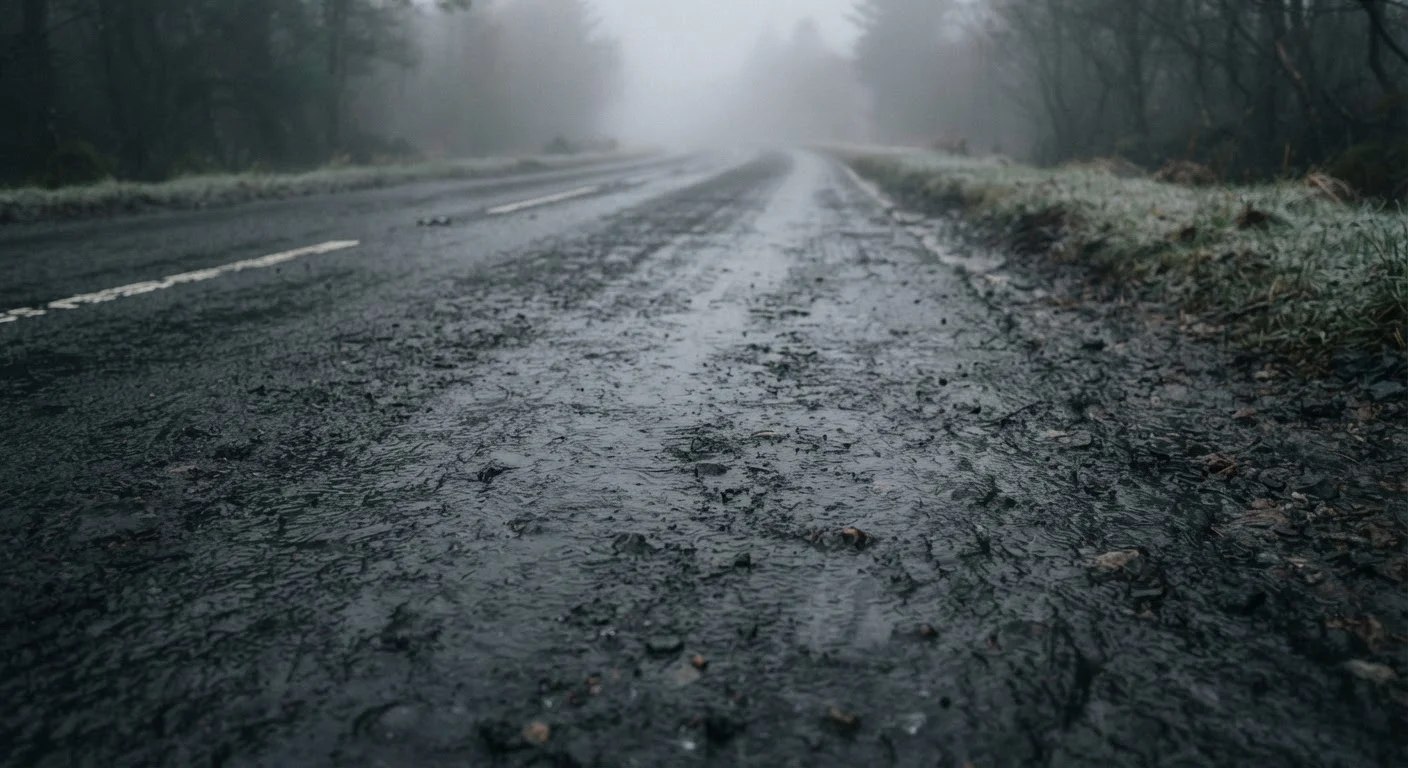
Black ice is not actually black. It is a thin, nearly transparent layer of frozen water that takes on the color of the pavement beneath it, making it almost impossible to see before a vehicle is already on top of it. It forms when temperatures drop near freezing and moisture on the road surface freezes without the visual cues drivers expect from snow or frost.
Bridges and overpasses freeze before surrounding road sections because cold air circulates under them from both sides. Shaded stretches of highway, intersections where traffic slows and drips coolant or water, and areas near drainage runoff are also common formation zones. Drivers who rely on visual confirmation of road conditions before adjusting their speed are consistently caught unprepared.
Understanding what defensive driving actually requires starts with treating road conditions as potentially hazardous before there is visible evidence, not after.
Common mistakes drivers make on ice
Braking hard when the vehicle first hits ice.
Why it happens: Hard braking is the automatic response to feeling the vehicle slip, because it works on dry roads. On ice, locking the wheels removes the rolling friction that tires need to steer.
Assuming all-wheel drive provides stopping advantage on ice.
Why it happens: All-wheel drive improves traction during acceleration, which makes it feel more capable overall. Drivers extend this assumption to braking, where AWD provides no mechanical advantage.
Overcorrecting the steering wheel during a skid.
Why it happens: The panic response to a slide is to turn the wheel sharply in the opposite direction. On ice, this creates a counter-skid when tires briefly regain grip, often throwing the vehicle the other way.
Driving at normal speeds because the road appears wet rather than icy.
Why it happens: Black ice has no visual marker. Drivers scan for snow or visible frost and, seeing only what looks like a damp surface, do not reduce speed.
Accelerating too soon after a curve or stop on ice.
Why it happens: Drivers are accustomed to accelerating the moment a vehicle exits a curve or starts moving from a stop. Applying too much throttle on ice breaks rear-wheel traction and causes the vehicle to slide sideways.
Following too closely behind other vehicles on icy roads.
Why it happens: Normal following distance feels sufficient because drivers calibrate it based on dry-road stopping experience. Stopping distances on ice can be ten times longer than on dry pavement.
Many of these errors trace back to the same root problem: drivers apply warm-weather instincts to frozen conditions. The inputs that work on dry asphalt, sharp braking, quick steering corrections, accelerating out of a slow spot, work against a driver on ice. Recognizing that ice changes the physics of the road is the first correction to make.
Smooth, gradual inputs protect traction in normal conditions and matter even more on ice. Abrupt changes in speed or direction are the fastest way to lose control.
What to do when the vehicle begins to skid
Do not steer against the direction of a skid
Turning the steering wheel sharply away from the direction of a slide is the most common error drivers make mid-skid. It causes the tires to snap in the opposite direction when grip returns, often making the vehicle harder to control than before the correction. Steer gently toward the direction of the skid and use minimal brake input until the vehicle straightens.
When a vehicle skids on ice, the instinct most drivers act on is the wrong one. Lifting off the accelerator sharply, stamping the brake, and turning the wheel hard in the opposite direction of the slide all amplify the loss of control rather than stopping it.
For a rear-wheel skid, sometimes called fishtailing, the correction is to steer gently in the direction the rear of the vehicle is sliding. If the rear slides right, steer right. The goal is to realign the front wheels with the direction of travel, not to fight the skid with counter-force.
For front-wheel skids, where the front of the vehicle pushes wide regardless of steering input, the correction is to ease off the accelerator and wait for the front tires to regain grip before attempting to steer again. Turning harder does not help.
Modern vehicles with electronic stability control (ESC) apply individual wheel braking automatically to assist, but ESC has physical limits. On severe ice, it reduces the severity of a skid rather than eliminating it. Drivers should not treat ESC as a substitute for reduced speed.
For drivers new to highway travel, understanding how speed amplifies these dynamics is important before encountering winter conditions at highway speeds.
Preparing before you drive in winter conditions
10x
Longer stopping distance on ice vs. dry pavement
The Federal Highway Administration notes that stopping distances on ice can be up to ten times longer than on dry road surfaces at equivalent speeds.
24%
Of weather-related crash fatalities occur on icy or snowy roads
According to the Federal Highway Administration, roughly 24 percent of weather-related vehicle crashes happen on snow- or ice-covered pavement.
1 PSI
Tire pressure lost per 10-degree Fahrenheit temperature drop
The National Highway Traffic Safety Administration notes that tire pressure decreases by approximately one PSI for every 10-degree Fahrenheit drop in ambient temperature.
Tire condition is the single most consequential factor in ice traction. All-season tires lose flexibility below about 45 degrees Fahrenheit, reducing their grip on cold or frozen surfaces. Dedicated winter tires use a different rubber compound that stays pliable in low temperatures and have tread patterns designed to channel slush and grip ice.
Tire pressure drops roughly one PSI for every 10-degree Fahrenheit drop in temperature, so tires that are correctly inflated in fall may be noticeably underinflated by winter. Underinflated tires reduce the contact patch and worsen handling on slippery surfaces.
Speed management before reaching a problem area matters more than speed management on it. Slowing down on the approach to a bridge, a curve, or a shaded section gives tires time to adjust and keeps stopping distances manageable. Once on the ice, braking options shrink considerably.
Nighttime driving compounds ice risk because surface temperatures drop further after dark and visibility of road conditions is lower. Headlights do not reveal black ice, so reduced speed and increased following distance become more important after sunset in freezing conditions.