
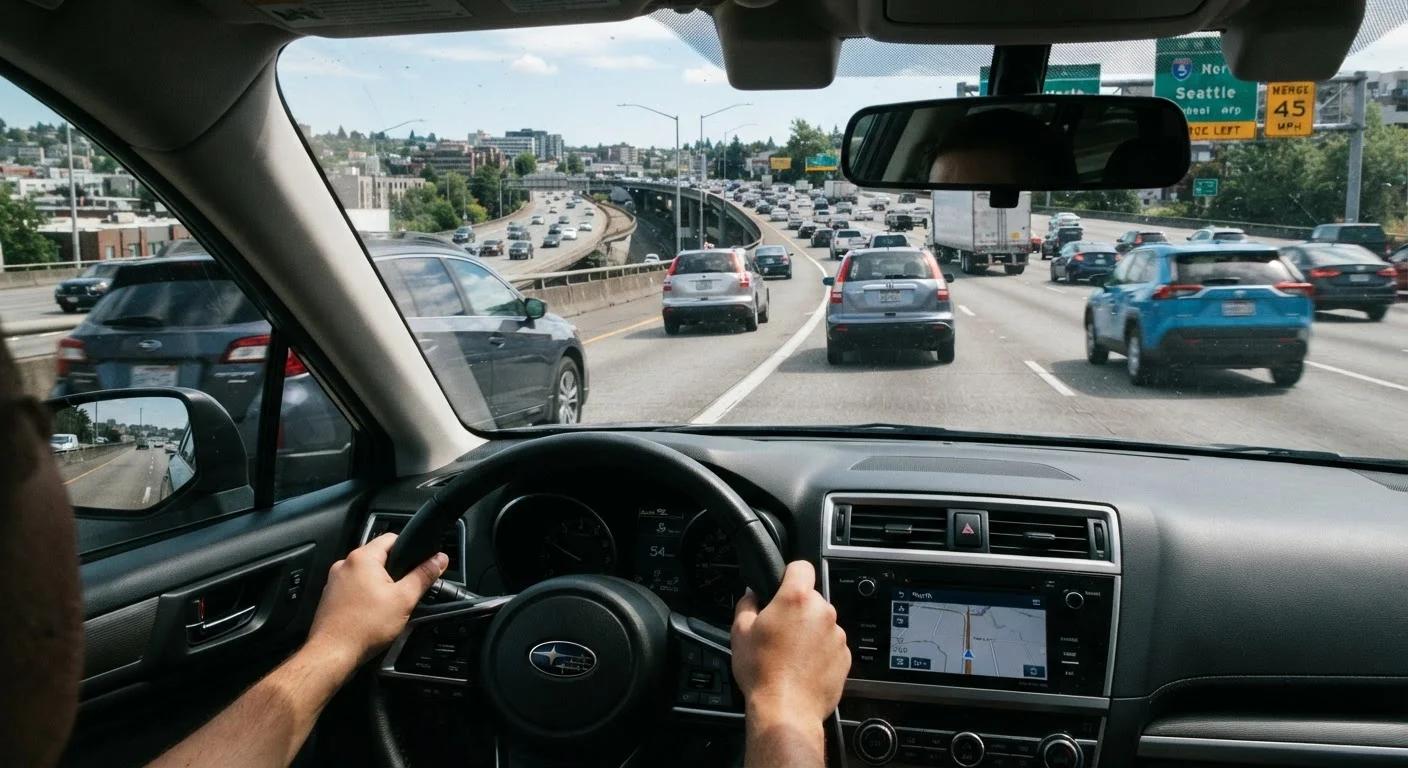
Why merging goes wrong
Most merge-related crashes trace back to two mistakes: entering too slowly or failing to check blind spots before moving over. Both errors give surrounding drivers no time to adjust. At 65 mph, traffic covers roughly 95 feet per second. A driver who merges at 45 mph is a moving obstacle in a lane where everyone else is traveling 20 mph faster.
The on-ramp is not a waiting area. It is a speed-building zone designed to bring you to highway speed before the lane ends. Drivers who treat it as a slow approach create the exact hazard they are trying to avoid. Highway driving fundamentals cover this in detail, but the core rule is simple: accelerate through the ramp, not onto the highway.
Blind spots compound the problem. A quick mirror check alone is not enough. The area alongside and just behind your rear quarter panel does not appear in side mirrors at all. Every merge requires a physical shoulder check before committing to the lane change.
What you need before you merge
What you will need
Beyond the physical prerequisites, the mental component matters. Defensive driving involves reading traffic patterns well ahead, not reacting to them at the last second. On a merge, that means scanning the target lane from the moment you enter the ramp, not at the end of it.
Step-by-step merging process
Scan the target lane as you enter the ramp
As soon as you begin the on-ramp, use your mirrors to assess the speed and density of highway traffic in the lane you plan to enter. Identify whether traffic is moving at a consistent speed or bunching up. Look for a usable gap now, before you need it.
Build speed to match highway traffic
Use the full length of the on-ramp to accelerate to the speed of the vehicles in the target lane. Your goal is to arrive at the merge point traveling at the same speed as surrounding traffic, not just close to it. A 10-to-15-mph difference is still a significant hazard.
Check mirrors, then perform a blind spot check
Once you have reached speed and identified a gap, check your left side mirror to confirm gap size. Then turn your head and look over your left shoulder to check the blind spot area that the mirror cannot show. Do this in sequence, not simultaneously.
Signal your intent
Activate your left turn signal. This communicates your intention to highway drivers and gives them a moment to adjust if needed. Signal before you begin moving laterally, not while you are already in the process of changing lanes.
Merge smoothly into the confirmed gap
Once the gap is confirmed and your signal is on, steer gradually into the highway lane. A smooth, steady steering input is safer than a sharp cut across the line. Avoid abrupt acceleration or braking as you complete the lane change.
Cancel the signal and stabilize your position
After you are fully in the lane, cancel your turn signal and maintain a consistent speed. Match the flow of traffic around you and establish a safe following distance from the vehicle ahead. Avoid immediately changing lanes again until you are fully settled.
After you merge, maintain your lane position for at least a few seconds before considering any further lane changes. Stacking maneuvers close together reduces your reaction window and the reaction window of drivers around you. Following distance principles apply just as much after a merge as they do during steady highway travel.
Smooth acceleration protects your vehicle too
Aggressive ramp acceleration followed by sudden braking after merging adds wear to your brakes, tires, and drivetrain over time. Consistent, controlled acceleration and early braking on the highway protect more than just your safety. For more on this connection, see safe driving habits that reduce vehicle wear.
Situations that change the approach
Not every merge follows the same script. Short on-ramps, heavy stop-and-go traffic, and construction zones each require adjustments.
Short on-ramps: When the ramp is brief, accelerate earlier and more aggressively. You have less distance to work with, so every second counts. If traffic is too dense to find a gap, slow to the ramp's end carefully, but stopping is a last resort because drivers behind you may not expect it.
Heavy or stopped highway traffic: When highway speeds drop below 25 mph, the speed-matching goal still applies, but the gap you need shrinks. Look for any consistent opening and use your turn signal early so drivers ahead of you know your intent.
Merging from a lane that is ending mid-highway (zipper merge): Many drivers abandon a closing lane early, but traffic research consistently shows that using the lane to its end and alternating one car at a time produces the smoothest flow. Do not feel pressured to merge prematurely when the lane is still open.
Aggressive driving from highway traffic is a separate risk. If a driver refuses to yield or accelerates to block you, do not force the merge. Slow down, find the next gap, and move over safely. No position on the road is worth a collision. For context on how following distance failures turn dangerous at speed, see this breakdown of tailgating and stopping distance.