How to tell a weed from a grass plant
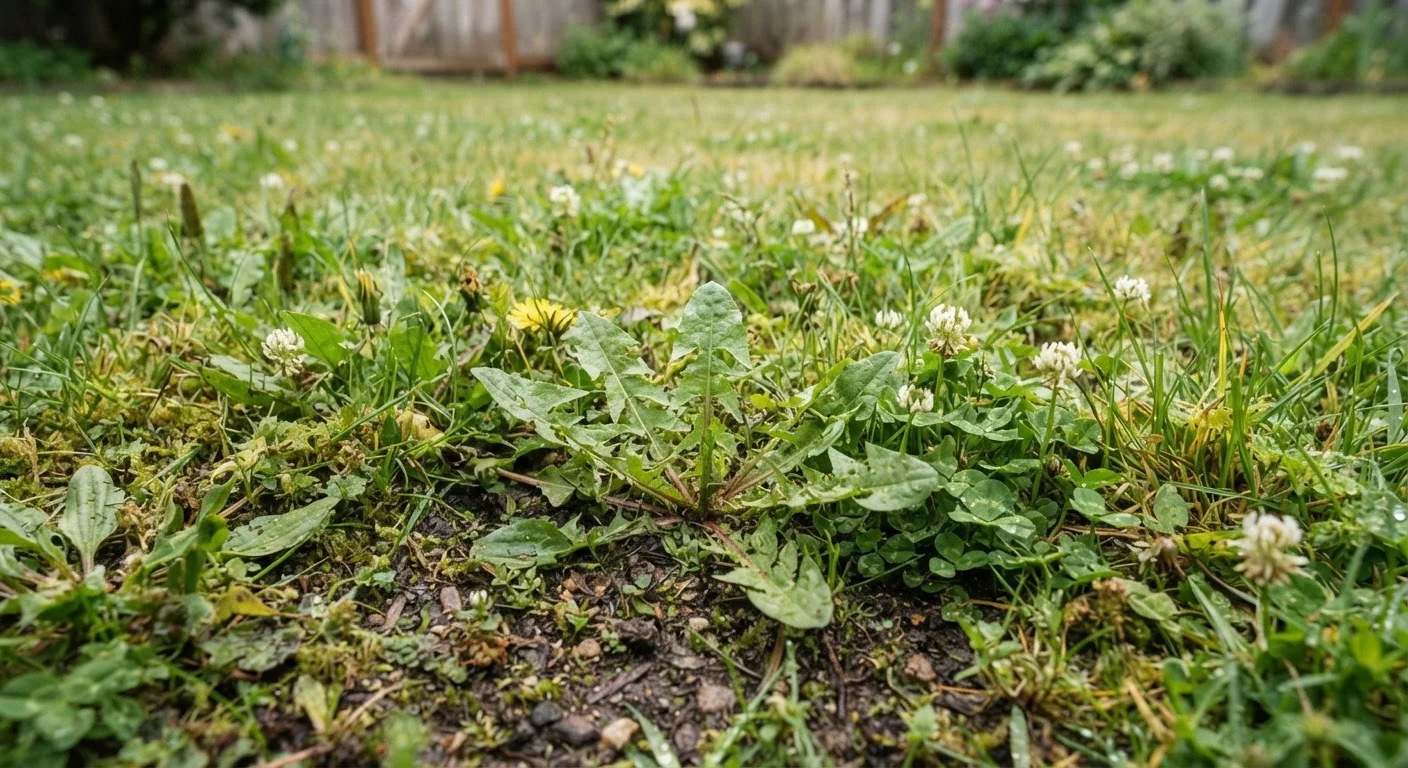
A weed is simply a plant growing where you do not want it. That definition is practical, not botanical. Some plants homeowners call weeds, like white clover, were once intentionally seeded into lawns. Others, like crabgrass, spread aggressively and crowd out desirable turf. Knowing which category a plant belongs to shapes how you respond to it.
The fastest way to identify an unknown plant is to look at three things: leaf shape, growth habit (does it spread flat or stand upright?), and where it appears in the lawn. Weeds that emerge in thin or bare patches often signal a soil or care issue rather than a random invasion. A dense, well-fed lawn is the most reliable long-term weed barrier.
For a season-by-season view of when weeds tend to emerge and how lawn care tasks intersect with control, see our month-by-month lawn care calendar.
Annual weed
A weed that completes its full life cycle, from germination to seed production, within a single year. It dies after setting seed but can leave large numbers of seeds in the soil.
Perennial weed
A weed that lives for more than two years, often regrowing from roots, rhizomes, or tubers after the top growth is removed.
Stolon
An above-ground stem that grows horizontally and produces new roots and shoots at its nodes, allowing a plant to spread across the soil surface.
Taproot
A single thick main root that grows straight down into the soil. Plants with taproots, like dandelions, regrow if the root is not fully removed.
Rhizome
An underground stem that grows horizontally and sends up new shoots at intervals, spreading the plant even when surface growth is removed.
Sedge
A grass-like plant with triangular stems and leaves arranged in groups of three. Sedges are distinct from true grasses and generally do not respond to the same control methods.
Broadleaf weeds: the ones you probably recognize
Broadleaf weeds have wide, flat leaves with a visible network of branching veins, which makes them stand out against narrow grass blades.
| Broadleaf weed leaf veins | Branching network pattern |
| Grass weed leaf veins | Parallel lines running lengthwise |
| Dandelion taproot depth | Up to 6 inches or more |
| Crabgrass germination threshold | Soil temperature around 55 degrees F |
| Nutsedge stem shape | Triangular cross-section |
| Clover nitrogen behavior | Fixes nitrogen from air; thrives in low-fertility lawns |
Dandelion (Taraxacum officinale)
Dandelions grow from a deep taproot and form a flat rosette of jagged-edged leaves at ground level. The bright yellow flowers mature into white seed heads that spread by wind. Because the taproot can reach six inches or deeper, pulling the plant without removing the full root usually results in regrowth. Dandelions prefer compacted soil and are a common early-spring indicator that aeration may help. Our article on lawn aeration covers when that step is worth taking.
White clover (Trifolium repens)
White clover has three rounded leaflets, often with a pale chevron mark, and produces small white rounded flowers. It spreads by stolons (above-ground stems that root at nodes), forming dense mats. Clover fixes nitrogen from the air, so it often thrives in low-fertility lawns. If clover is widespread, the lawn may simply need feeding. Checking your approach against common lawn fertilizing myths is a good starting point before reaching for a herbicide.
Plantain (Plantago major and P. lanceolata)
Broadleaf plantain has wide oval leaves with strong parallel ribs; narrow-leaf plantain has lance-shaped leaves. Both grow in a ground-hugging rosette and tolerate heavy foot traffic and compacted soil. They spread by seed and are most common along paths and in high-traffic lawn areas.
Chickweed (Stellaria media)
Chickweed is a low, mat-forming annual with small oval leaves and tiny white star-shaped flowers. It germinates in cool weather, often appearing in fall or early spring, and dies back when temperatures rise. It prefers moist, shaded spots and fertile soil.
Grassy weeds: harder to spot, harder to remove
Grassy weeds look like grass, which makes them harder to identify until they are well established. They have narrow leaves with parallel veins and hollow or pithy stems.
Crabgrass (Digitaria sanguinalis and D. ischaemum)
Crabgrass is a warm-season annual that germinates when soil temperatures reach about 55 degrees Fahrenheit and spreads outward in a crab-like, flat pattern from a central point. Leaves are wider than most lawn grasses and slightly hairy. A single plant can produce thousands of seeds before it dies at first frost, which is why late-summer patches can become next-year problems. Thin, dry turf gives it room to establish. Our guide on proper watering schedules explains how drought stress opens the door to crabgrass.
Annual bluegrass (Poa annua)
Annual bluegrass is a cool-season annual with boat-shaped leaf tips and a pale green color that contrasts with darker turf grasses. It produces seed heads even when mowed short and forms clumping patches that die in summer heat, leaving bare spots. It thrives in overwatered or poorly draining areas.
Nutsedge (Cyperus esculentus)
Nutsedge is not a true grass; it is a sedge. Its leaves are thicker, waxy, and arranged in groups of three around a triangular stem (grass stems are round or flat). It grows faster than lawn grass in warm weather and stands noticeably taller a few days after mowing. Nutsedge spreads through underground tubers called nutlets, which makes it particularly persistent.
Vine and creeping weeds
Some weeds spread horizontally across the lawn surface rather than growing upright.
Ground ivy (Glechoma hederacea)
Ground ivy has round, scallop-edged leaves with a distinct minty smell when crushed and small purple flowers in spring. It spreads by creeping stems that root at nodes and does best in shaded, moist areas where grass is thin. Once established, it is difficult to remove by hand because stem fragments re-root.
Bindweed (Convolvulus arvensis)
Bindweed has arrow-shaped leaves and produces trumpet-shaped white or pale pink flowers. It twines around other plants and sends roots several feet deep. Because the root system is extensive, hand-pulling provides only temporary control.
If you are rebuilding a lawn that has heavy weed pressure, it may be worth reviewing the tradeoffs covered in our article on grass seed versus sod before deciding on a restoration approach.